Board-Level Guide to High-Risk Payment Risk: What Executives Must Know
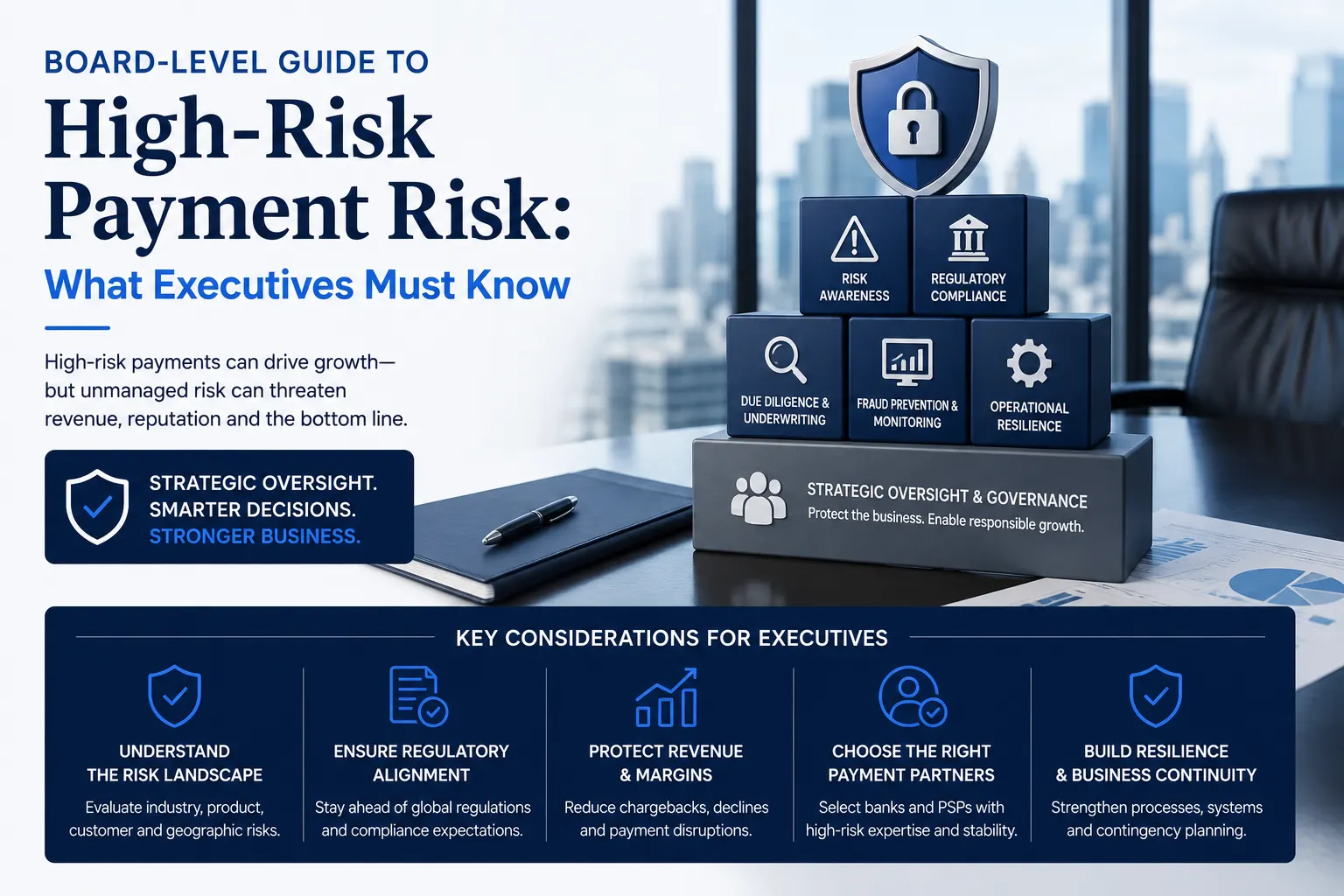
TL;DR: High-risk payment risk is a board-level issue, not just an operations problem. A single debanking event, a chargeback ratio breach, or a regulatory enforcement action can halt revenue entirely within 48 hours. Executives who understand payment infrastructure risk as a strategic exposure, and govern it accordingly, protect shareholder value. Those who treat it as a technical detail discover the hard way that it isn't.
Payment infrastructure risk sits in an uncomfortable gap in most high-risk merchant organisations. It is too technical for most boards to engage with directly. It is too consequential to leave entirely to operations teams. And it is too frequently treated as a back-office concern, until a payment gateway termination, a card scheme monitoring programme, or a regulatory inquiry makes it front-page news internally.
This guide translates the operational complexity of high-risk payment processing risk into strategic language that executives and board members can act on, without requiring deep technical expertise.
Why Payment Risk Is a Board-Level Issue
The Revenue Concentration Reality
For most high-risk merchants, payment processing is not a support function, it is the single most critical piece of infrastructure the business depends on. Consider:
- 100% of revenue flows through payment gateways and merchant accounts
- A single acquirer termination can halt all revenue within 24–48 hours with no transition period
- A chargeback ratio breach that triggers card scheme monitoring can impose $25,000–$200,000 monthly fines before the issue is resolved
- A regulatory enforcement action against a payment provider can freeze merchant funds for 30–90 days
According to the Global Financial Innovation Network's 2025 survey, 74% of high-risk businesses experienced at least one payment account closure or processing suspension in the prior 12 months. Among those, the average revenue impact was $180,000–$500,000 per incident.
This is not an operational detail. It is a strategic risk that belongs on the board's agenda alongside credit risk, regulatory risk, and cybersecurity risk.
The Governance Gap
Most boards of high-risk merchants receive regular reporting on financial performance, regulatory compliance, and operational KPIs. Very few receive structured reporting on payment infrastructure risk, specifically:
- Current chargeback ratios vs card scheme thresholds
- Number and diversity of active merchant account relationships
- Rolling reserve capital locked across processors
- Payment provider financial health and regulatory standing
- Exposure to any single gateway or acquirer relationship
Without this information, boards cannot make informed decisions about payment risk concentration, processor diversification, or compliance investment. The governance gap creates the conditions for avoidable, catastrophic payment infrastructure failures.
The Five Payment Risks Executives Must Understand
Risk 1 - Debanking and Account Termination
What it is: The sudden closure of a merchant account or banking relationship, by the payment processor, acquirer, or banking partner, without adequate notice.
Why it happens for high-risk merchants:
- Chargeback ratio breach triggering card scheme monitoring
- Upstream correspondent bank de-risking the acquirer's portfolio
- Regulatory investigation or enforcement action against the processor
- Policy changes at the processor covering the merchant's vertical
- AML compliance failure at merchant or processor level
Board-level question: How many independent payment gateway and acquirer relationships does the business maintain? If the primary relationship terminated tomorrow, what is the revenue continuity plan and what is the recovery timeline?
Governance action: Mandate a minimum of two active, tested backup merchant account relationships as a board-level policy, not a management aspiration.
Risk 2 - Chargeback Ratio Exposure
What it is: The proportion of transactions that generate formal chargebacks, measured against card scheme thresholds. Visa's VAMP threshold is 0.9%; Mastercard's ECP threshold is 1.5%.
Why it matters at board level:
- Breaching thresholds triggers monitoring programme placement, automatically, with no appeals process
- Monthly fines escalate rapidly: from $1,000 at month 1 to $200,000+ at month 12 under Mastercard ECP
- Termination and MATCH listing follows non-remediation, a 5-year blacklist from card scheme acquiring
- The financial impact of a chargeback ratio crisis compounds monthly it goes unaddressed
Statistical context: Chargebacks411's 2025 data shows that high-risk merchants who enter card scheme monitoring programmes take an average of 4.7 months to exit, during which cumulative fines average $187,000 for Mastercard ECP and $95,000 for Visa VAMP at standard tiers.
Board-level question: What is the current chargeback ratio across all processing relationships? Is this reported to the board monthly? What is the threshold at which management escalates to board level?
Governance action: Establish a board-level chargeback ratio escalation trigger, for example, mandatory board notification if ratio exceeds 0.75% (below VAMP threshold) so that remediation begins before a breach.
Risk 3 - Regulatory and Compliance Risk
What it is: The risk that the business, its payment providers, or its banking partners face regulatory action that disrupts payment processing operations.
Sources of regulatory risk for high-risk merchants:
- CFPB expanded supervision of large nonbank payment processors (US)
- FCA payment firms supervisory strategy, financial resilience and AML enforcement (UK)
- MiCA enforcement for crypto-adjacent payment flows (EU)
- AUSTRAC examination of digital currency exchanges (Australia)
- FINTRAC compliance examinations for MSBs (Canada)
Board-level question: Which regulators have jurisdiction over the business's payment operations? Is the business a regulated entity itself (MSB, CASP, licensed operator) or does regulatory risk flow primarily through payment providers? What is the regulatory standing of each key payment provider relationship?
Governance action: Include payment regulatory compliance in the board's annual risk register, with named ownership, current status, and forward-looking risk assessment.
Risk 4 - Rolling Reserve Capital Lock-Up
What it is: The capital held by payment providers as security against future chargebacks, typically 5–15% of processing volume, held for 90–180 days. This capital is the merchant's money but is inaccessible during the reserve period.
Why it matters at board level:
- At $5M monthly processing with a 10% reserve on 180-day terms: $3 million in locked capital at steady state
- Rolling reserve exposure scales with processing volume, rapid growth creates rapid capital lock-up
- New processor relationships typically require immediate reserve funding, growth without capital planning creates a liquidity gap
Board-level question: What is the total rolling reserve capital currently locked across all payment provider relationships? How does this scale with projected processing volume growth? Is this adequately reflected in working capital planning?
Governance action: Require finance to include rolling reserve capital in the company's working capital model, as a specific line item that scales with payment processing volume.
Risk 5 - FX and Settlement Currency Risk
What it is: The exposure created when settlement currencies differ from operating currencies, amplified by multi-currency processing across international markets.
Why it matters for high-risk merchants: As covered in the treasury management guide, a 3–5% adverse currency movement on $5M monthly multi-currency settlement can represent $150,000–$250,000 in lost margin per month, without any change in business performance.
Board-level question: What currencies does the business settle in? What is the unhedged FX exposure at current processing volumes? Is there a documented FX risk management policy?
Governance action: Mandate an FX risk policy, even if the initial policy simply documents the exposure and defers hedging decisions until scale warrants it.
Board Reporting Framework for Payment Risk
Most boards receive no structured payment risk reporting. A practical minimum reporting framework for high-risk merchants:
Monthly Dashboard Metrics
Metric
What to Report
Escalation Trigger
Chargeback ratio
Current ratio vs VAMP/ECP thresholds
>0.70% Visa / >1.20% Mastercard
Active merchant accounts
Count and status of all active relationships
Any unplanned termination
Rolling reserve balance
Total locked capital across all processors
>15% of monthly processing volume
Gateway uptime
Processing availability vs SLA
Any sustained outage >30 minutes
Processor financial status
Any regulatory action or news
Any FCA/CFPB/AUSTRAC enforcement against key providers
Settlement currency exposure
Unhedged FX exposure in USD equivalent
>$500K unhedged exposure
Quarterly Risk Review
Beyond monthly metrics, a quarterly payment risk review should cover:
- Provider diversification: Are relationships genuinely diversified or concentrated?
- Contract renewal calendar: Which processor agreements are approaching expiry?
- Regulatory development: What regulatory changes affect payment operations?
- Competitive intelligence: Are alternative payment providers in the market offering better terms or coverage?
- Compliance programme status: Is AML/KYB documentation current? When was the last external review?
What Good Payment Risk Governance Looks Like
Policy Requirements
Boards of high-risk merchant companies should formally adopt:
1. Payment Infrastructure Diversification Policy: Minimum two active merchant accounts with different acquirers, tested and ready for volume. Maximum 80% of processing volume through any single payment provider.
2. Chargeback Ratio Management Policy: Internal escalation trigger below card scheme thresholds. Designated owner for chargeback ratio management. Mandatory board reporting on any ratio breach.
3. Rolling Reserve Capital Policy: Rolling reserve capital included in working capital planning. Maximum acceptable reserve lock-up as a percentage of operating capital.
4. Payment Provider Due Diligence Policy: Minimum due diligence standards for new payment provider relationships, regulatory standing, financial health, vertical acceptance history. Annual review of existing provider relationships.
5. FX Risk Management Policy: Documentation of settlement currency exposure. Defined threshold above which hedging is mandated.
The CEO and CFO's Specific Responsibilities
CEO responsibilities:
- Ensure payment infrastructure risk is represented in the company's strategic risk assessment
- Champion payment provider diversification as an operational priority, not a cost centre
- Engage with the company's primary payment provider relationships at senior level
CFO responsibilities:
- Own rolling reserve capital modelling and working capital impact
- Own FX risk assessment and hedging policy
- Present payment financial risk to the board as part of treasury risk reporting
- Ensure the business has adequate capital to fund new processor relationships if primary relationships terminate
Common Executive Misconceptions About Payment Risk
"Our payment provider handles all compliance, we don't have direct exposure." This is the most common and most dangerous misconception. When your merchant account is terminated, the compliance failure can be entirely your processor's, but your revenue stops immediately regardless. The exposure is operational regardless of where regulatory fault lies.
"We have a backup processor on standby." "On standby" is not the same as "active and tested." A backup payment gateway that has never processed a live transaction will not perform reliably when switched to urgently. Backup processors must be active, configured, and regularly tested with real transactions.
"Our chargeback ratio is fine, we checked last quarter." Chargeback ratios can move from compliant to breach territory in a single high-dispute month. Monthly monitoring, not quarterly, is the minimum acceptable cadence for high-risk merchants operating anywhere near card scheme thresholds.
"We can find a new processor quickly if we need to." Specialist high-risk payment processor approval takes 4–8 weeks minimum with complete documentation. In an emergency debanking scenario, with incomplete documentation and urgency-driven application quality, it takes longer. The time to establish relationships is before you need them.
Pros and Cons of Board-Level Payment Risk Governance
Pros
- Prevents avoidable revenue disruptions: most debanking events are preceded by warning signs that board-level monitoring would catch earlier
- Improves investor and stakeholder confidence: structured payment risk governance signals operational maturity
- Enables faster incident response: pre-approved response protocols reduce decision time in a payment crisis
- Better commercial terms: boards that mandate diversification give management the authority to invest in multiple provider relationships
- Regulatory protection: documented governance provides a defence in regulatory investigations
Challenges
- Technical complexity: payment risk is genuinely complex; boards need management to translate effectively
- Reporting infrastructure: building monthly payment risk dashboards requires operational data that many businesses don't currently aggregate
- Management resistance: payment operations teams sometimes resist board-level scrutiny of their domain
- False confidence risk: dashboards and policies provide structure but not protection if underlying risks are not genuinely managed
Frequently Asked Questions
Q: Should payment risk have a dedicated board committee or sit within an existing committee?
A: For most high-risk merchants, payment risk fits naturally within an existing Audit and Risk Committee, alongside credit, regulatory, and cybersecurity risk. Boards with particularly complex payment operations may benefit from dedicated payment risk reporting at a full board level quarterly.
Q: What is the single most important payment risk metric for a board to track?
A: Chargeback ratio vs card scheme thresholds, it is the most time-sensitive, most consequential, and most directly actionable payment risk metric. A ratio trending toward a breach threshold with no board visibility is the most common precursor to a payment crisis.
Q: How should the board respond if the company's primary payment provider is under regulatory investigation?
A: Treat it as an active continuity risk. Accelerate onboarding of backup payment gateway and acquirer relationships. Request from management a 48-hour payment continuity plan. Monitor the regulatory situation monthly until resolved.
Q: Do offshore merchant boards have the same payment risk governance obligations?
A: The governance obligations are not legally mandated in most offshore jurisdictions, but the operational risks are identical. Offshore merchants operating high-risk payment processing face the same debanking, chargeback, and regulatory risks as onshore businesses. The case for board-level governance is the same regardless of jurisdiction.
Final Thoughts
Payment infrastructure risk is not a technical problem that executives can safely delegate and forget. It is a strategic exposure that, when it materialises, does so with speed and severity that leaves no time for governance to catch up. The boards of high-risk merchants that govern payment risk well are those that receive structured monthly reporting, have adopted clear policies on diversification and compliance, and understand that their payment processing infrastructure is as strategically critical as any other part of the business.
→ Explore TheFinRate's high-risk merchant services directory to benchmark your payment provider relationships and identify backup options before you need them. https://thefinrate.com/board-level-guide-to-high-risk-payment-risk-what-executives-must-know/


Comments
Post a Comment