Visa VAMP Program 2026: What High-Risk Merchants Must Do Before October
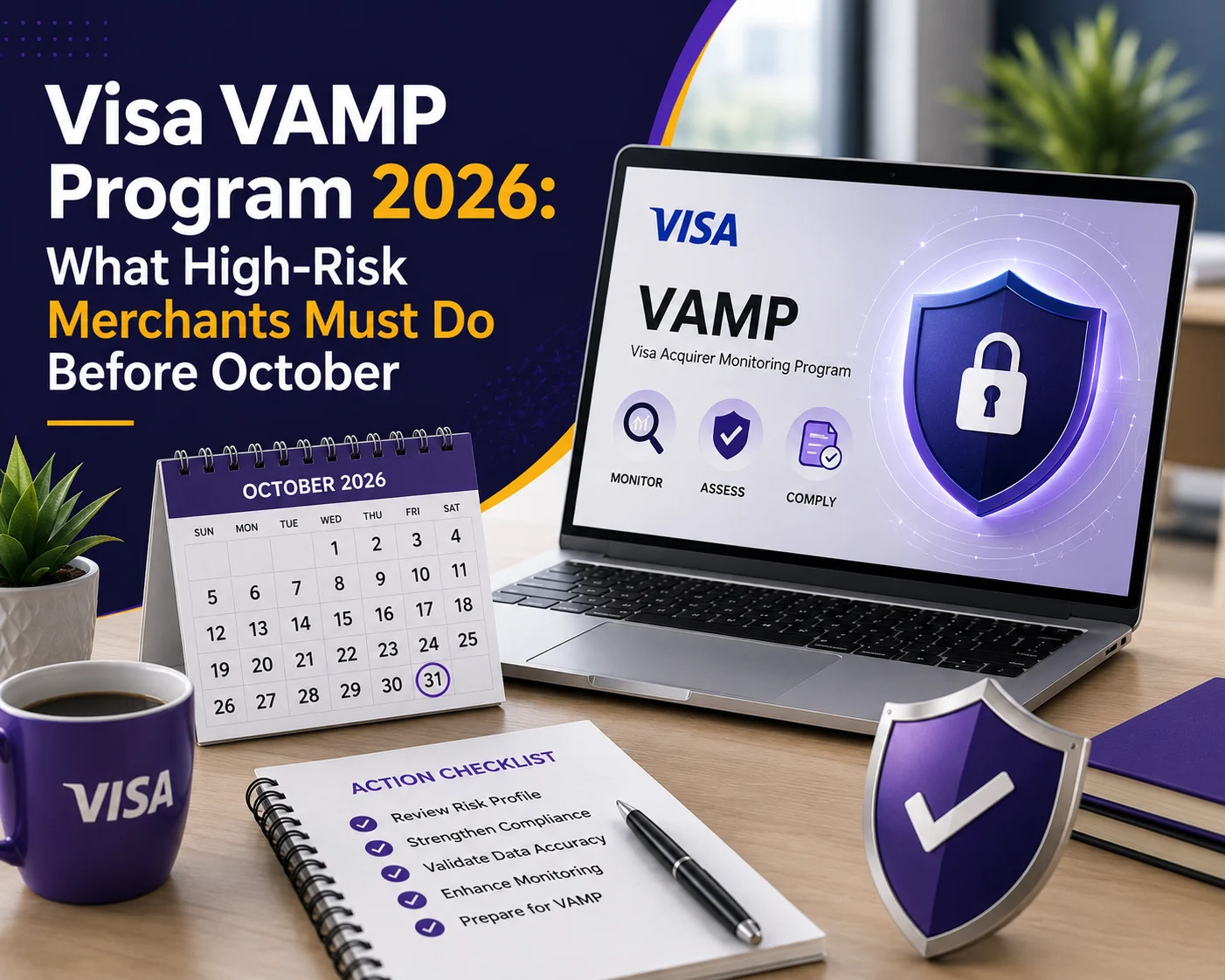
TL;DR: Visa's new VAMP (Visa Acquirer Monitoring Program) consolidates the old VDMP and VFMP into a single, stricter framework effective April 2026, with full enforcement from October 2026. High-risk merchants above the new dispute thresholds face escalating monthly fines and potential merchant account termination. Act now, October is closer than it looks.
Visa has restructured how it monitors and penalises merchants for excessive disputes, and the new framework is more comprehensive, more automated, and less forgiving than what came before. The Visa Acquirer Monitoring Program (VAMP), which becomes fully enforced in October 2026, replaces two legacy programmes and introduces a unified dispute metric that high-risk merchants need to understand immediately.
If your merchant account is in a high-risk vertical, gambling, nutraceuticals, adult content, subscription billing, forex, or travel, this change directly affects your operating risk. Here's everything you need to know and act on before the October enforcement deadline.
What Is the Visa VAMP Program?
VAMP, the Visa Acquirer Monitoring Program: is Visa's consolidated dispute monitoring framework launched in April 2026. It replaces two previously separate programmes:
- VDMP (Visa Dispute Monitoring Program): Monitored merchants for excessive chargeback volumes
- VFMP (Visa Fraud Monitoring Program): Monitored merchants for excessive fraud-to-sales ratios
Under the old system, a merchant could theoretically manage VDMP and VFMP compliance separately, optimising for each metric independently. VAMP eliminates this by introducing a single combined metric, the VAMP Ratio, that captures both disputes and fraud in one calculation.
The VAMP Ratio: How It's Calculated
The VAMP Ratio is calculated as:
VAMP Ratio = (Chargebacks + TC40 Fraud Reports) ÷ Total Transactions
Where:
- Chargebacks = All dispute transactions reaching chargeback stage
- TC40 Fraud Reports = Issuer-reported fraud claims filed through Visa's TC40 system, whether or not they escalate to a formal chargeback
- Total Transactions = All Visa transactions processed in the period
This is a significant change. Under the old framework, TC40 fraud reports that didn't become chargebacks were largely invisible to VDMP monitoring. Under VAMP, they count, meaning merchants with strong chargeback management but high fraud report volumes can still breach the threshold.
VAMP Thresholds and Enforcement Tiers (2026)
Visa has established two enforcement tiers under VAMP, each with escalating consequences.
Standard Threshold
Metric
Threshold
VAMP Ratio
0.9% (9 disputes/fraud reports per 1,000 transactions)
Minimum volume
1,000 transactions per month
Minimum dispute count
75 chargebacks per month
Merchants must exceed both the ratio threshold and the minimum volume/count to enter the monitoring programme. This protects very small merchants from being penalised on low transaction volumes.
High-Risk Enhanced Threshold (Enforceable October 2026)
Metric
Threshold
VAMP Ratio
1.5% for merchants in designated high-risk MCCs
Excessive Tier
2.0% - triggers immediate escalation regardless of volume
Note: Visa has indicated that merchants in certain high-risk Merchant Category Codes (MCCs), including gambling (7995), adult entertainment (7273), and certain subscription categories, will face differentiated threshold enforcement from October 2026. Confirm your MCC classification with your payment provider immediately.
VAMP Fine Structure
Merchants placed in the VAMP programme face a structured fine schedule applied monthly by their acquirer:
Programme Month
Monthly Fine (Standard)
Monthly Fine (Excessive Tier)
Month 1–3
$0 (notification only)
$10,000
Month 4–6
$25,000
$50,000
Month 7–9
$50,000
$75,000
Month 10+
$75,000 + review for termination
$100,000 + termination review
Fines are assessed by the acquirer and passed to the merchant. They are non-negotiable once triggered. For high-risk merchants operating on thin margins, a month-4 fine of $25,000 can be existential.
How VAMP Differs from the Old VDMP/VFMP Framework
Feature
Old VDMP/VFMP
New VAMP
Number of programmes
Two separate programmes
One unified programme
Fraud metric included?
VFMP only (separate)
Yes — TC40 included in ratio
Threshold
VDMP: 1.0% chargebacks
0.9% combined VAMP ratio
TC40 reports counted?
No (VDMP) / Yes (VFMP)
Yes — all TC40s included
Acquirer liability
Merchant-facing only
Acquirer also monitored
Enforcement start
Ongoing
Full enforcement October 2026
High-risk MCC treatment
Standard thresholds
Differentiated thresholds
The most operationally significant change is the inclusion of TC40 fraud reports in the core ratio. Many high-risk merchants who managed their VDMP ratio well by intercepting chargebacks via Ethoca and CDRN may find their VAMP ratio is higher than expected, because TC40 reports filed by issuers, even on disputes that were refunded before chargeback, still count.
Why High-Risk Merchants Are Most Exposed
High-risk merchants face compounded VAMP exposure for several structural reasons:
- Higher baseline dispute rates: Verticals like gambling, adult, and nutraceuticals generate intrinsically higher dispute volumes than low-risk e-commerce
- Higher TC40 fraud report rates: CNP fraud is more prevalent in high-risk categories, generating more issuer-side fraud reports regardless of merchant action
- Lower average VAMP ratio headroom: Starting from a higher dispute baseline leaves less buffer before the 0.9% threshold is breached
- Multi-currency and offshore processing complexity: Offshore merchants processing across multiple currencies and jurisdictions can face misattribution of transactions that inflates their ratio
- Subscription and recurring billing patterns: High volumes of recurring transactions create systematic dispute exposure if cancellation management isn't airtight
What High-Risk Merchants Must Do Before October 2026
The April–October 2026 window is a grace period, Visa is monitoring but not yet applying the full fine schedule to all tiers. Use this window deliberately.
Calculate Your Current VAMP Ratio
Work with your payment gateway or acquirer to pull your current chargeback volume and TC40 fraud report volume against total Visa transaction count. Many merchants don't have direct visibility into their TC40 data, your acquirer does, and you should request this monthly reporting immediately.
VAMP Ratio = (Chargebacks + TC40s) ÷ Total Visa Transactions × 100
If your ratio is above 0.7%, you are in the caution zone and should treat it as urgent. Above 0.9% and you are already in breach territory.
Implement or Audit 3D Secure 2.0
3DS2 authentication shifts fraud liability to the issuing bank for authenticated transactions, meaning those transactions generate TC40 fraud reports against the issuer, not the merchant. This is the single most effective tool for reducing your VAMP ratio's fraud component.
If you are not running 3DS2 on all eligible Visa transactions through your payment gateway, implementing it before October is non-negotiable.
Activate Both Chargeback Alert Networks
Ethoca Alerts and Verifi CDRN both intercept disputes before they reach formal chargeback stage. While refunded pre-chargeback transactions still generate TC40 reports in some cases, reducing the volume of formal chargebacks is still critical to VAMP ratio management.
Merchants not yet enrolled in both networks should treat this as a compliance priority, not a cost-benefit question.
Audit Your Subscription and Recurring Billing Flows
Recurring billing disputes are one of the highest contributors to VAMP ratio breaches for subscription merchant accounts. Audit your cancellation flows, ensure cancellation confirmation emails are sent immediately, and consider implementing a cancellation save flow that resolves intent to cancel before billing triggers a dispute.
Review Your Billing Descriptor
Descriptor confusion, where customers don't recognise the merchant name on their statement, drives a significant volume of friendly fraud disputes and TC40 reports. Ensure your Visa billing descriptor is clear, branded, and consistent with what customers expect to see. Include a support phone number in your descriptor where the scheme allows.
Establish Monthly VAMP Ratio Reporting
VAMP breaches don't announce themselves, they accumulate. Establish a monthly reporting cadence with your payment provider that includes:
- Total Visa transaction volume
- Total chargebacks received
- Total TC40 fraud reports (request this specifically)
- Calculated VAMP ratio
- Month-over-month trend
Engage Your Acquirer Proactively
VAMP places increased compliance obligations on acquirers as well as merchants. Acquirers that receive excessive VAMP-flagged merchants face their own Visa sanctions. This means your merchant services provider has a direct incentive to help you stay compliant, and most will provide guidance, reporting, and support if you proactively engage them before a breach occurs.
Pros and Cons of the VAMP Framework
What VAMP Gets Right
- Unified metric eliminates the game of managing VDMP and VFMP separately
- TC40 inclusion gives Visa a more complete picture of merchant fraud exposure
- Acquirer-level monitoring incentivises payment providers to help merchants stay compliant
- Tiered enforcement with a notification-only initial period gives merchants time to remediate
Challenges for High-Risk Merchants
- TC40 inclusion: catches merchants whose chargeback management was previously effective, they now need to also manage fraud report volume
- 0.9% combined threshold: is lower than the previous 1.0% VDMP threshold, less headroom
- TC40 data visibility is limited: merchants must request it from acquirers who don't always share it proactively
- Offshore merchants: processing through multiple acquirers may find VAMP ratios calculated differently across relationships
- Fine escalation is rapid: a merchant that misses three months of monitoring can face $75,000+ in cumulative fines before corrective action takes effect
Frequently Asked Questions
Q: Does VAMP replace both VDMP and VFMP entirely? A: Yes. As of April 2026, VAMP is the single Visa dispute and fraud monitoring framework. VDMP and VFMP are no longer separately tracked programmes, though legacy cases already in those programmes may continue under transition rules.
Q: How do I find out my current TC40 fraud report volume? A: Request it directly from your acquirer or payment provider. TC40 data is not typically visible in standard merchant reporting dashboards, you may need to request a specific compliance report.
Q: Can I be in the VAMP programme without knowing it? A: Yes, the notification-only period in months 1–3 means some merchants may be in monitoring without having received a formal fine. Request your VAMP status from your acquirer explicitly.
Q: Do chargebacks that are won through representment still count toward my VAMP ratio? A: Yes. Chargebacks count when filed, not when resolved. A successful representment reverses the financial loss but does not remove the chargeback from your ratio calculation.
Q: Does VAMP apply to all card-not-present merchants or just high-risk? A: VAMP applies to all Visa merchants above the minimum volume threshold. However, high-risk merchants face differentiated thresholds and greater inherent exposure due to higher baseline dispute rates.
Q: What happens if my merchant account is terminated under VAMP? A: Termination results in placement on the Visa Terminated Merchant File (TMF), also known as the MATCH list, making it extremely difficult to obtain a new merchant account with any Visa-participating acquirer globally.
Final Thoughts
The Visa VAMP program is the most significant structural change to dispute monitoring in years, and the October 2026 full enforcement date is approaching faster than most high-risk merchants realise. The combined VAMP ratio, TC40 inclusion, and tightened thresholds mean that merchants who managed compliance comfortably under the old framework may find themselves in breach territory under VAMP without any change in their own behaviour.
The window between now and October is your remediation runway. Use it.
→ Find verified high-risk payment providers, chargeback management tools, and fraud prevention platforms on TheFinRate's merchant services directory. https://thefinrate.com/visa-vamp-program-2026-what-high-risk-merchants-must-do-before-october/


Comments
Post a Comment