Treasury Management for High-Risk Businesses: Hedging, FX & Multi-Bank Strategy
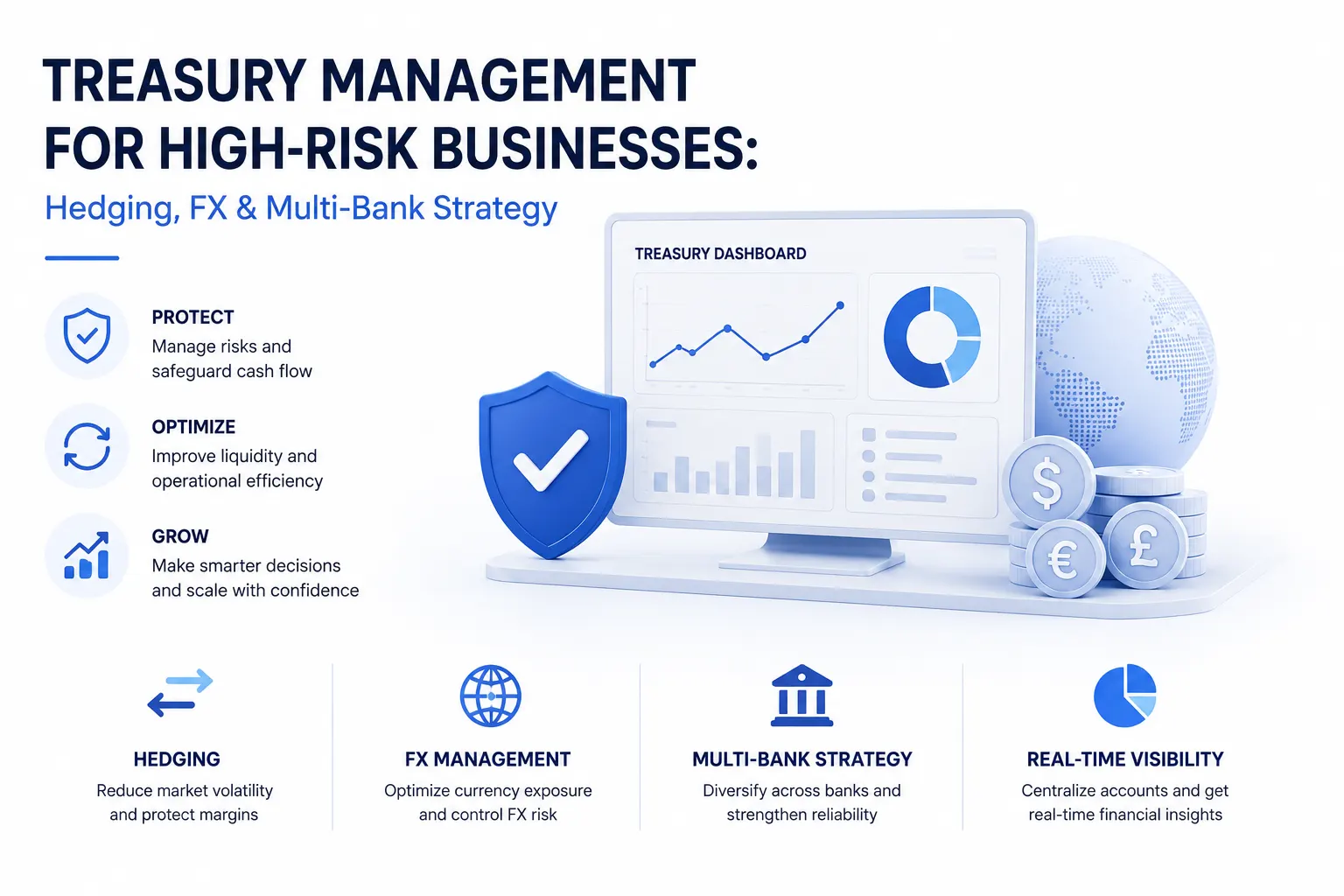
TL;DR: High-risk merchants face treasury challenges that standard businesses don't, rolling reserves locking capital for 90–180 days, multi-currency settlement creating FX exposure, and concentration risk from single-bank dependency. A structured treasury strategy, multi-bank architecture, FX hedging, and reserve management, protects revenue that payment processing generates. This guide covers what that looks like in practice.
Most high-risk merchants spend significant energy optimising their payment processing, approval rates, chargeback ratios, gateway redundancy. Fewer apply the same rigour to what happens after settlement: how funds are held, protected from currency risk, and managed across banking relationships that can terminate without warning.
Treasury management is the discipline that protects the revenue your payment gateway generates. For high-risk merchants and offshore merchants specifically, the risks are structural, rolling reserves, FX exposure across multiple settlement currencies, and the ever-present threat of debanking. This guide covers the strategies that address all three.
The Treasury Challenges Specific to High-Risk Merchants
Standard treasury management, cash flow forecasting, bank account management, basic FX, applies to all businesses. High-risk merchants face three additional challenges that standard businesses don't:
1. Rolling Reserves Create Capital Lock-Up
Every specialist high-risk payment processor holds a rolling reserve, typically 5–15% of processing volume, held for 90–180 days. This is not a fee; it is capital that belongs to the merchant but is inaccessible during the reserve period.
The scale of the problem: A high-risk merchant processing $1 million monthly with a 10% rolling reserve:
- Monthly reserve contribution: $100,000
- At steady state (180-day reserve): $600,000 locked up, capital earning nothing and unavailable for operations
- Any increase in processing volume increases the locked capital proportionally
For growth-stage high-risk merchants, rolling reserves are one of the most significant constraints on working capital, more impactful in practice than the processing rate itself.
2. Multi-Currency Settlement Creates FX Exposure
High-risk merchants processing internationally settle in multiple currencies, EUR, GBP, USD, AUD, CAD, and many have operating expenses primarily in one currency. The gap between settlement currency and operating currency creates FX exposure that accumulates across every settlement cycle.
Example: A UK-based high-risk merchant settling primarily in EUR from European customers:
- EUR settlement at €1M per month
- GBP operating expenses of £700,000/month
- At EUR/GBP 0.85: Settlement converts to £850,000 - £150,000 profit
- At EUR/GBP 0.82 (3.5% EUR weakness): Settlement converts to £820,000 - £120,000 profit
- FX movement eliminated £30,000 profit without any change in business performance
For offshore merchants processing across multiple currency corridors, unhedged FX exposure can dwarf the impact of processing rate negotiations.
3. Banking Concentration Risk
High-risk merchants that hold all operating funds with a single bank or BaaS provider face catastrophic risk if that provider terminates the relationship. As covered in the correspondent banking guide, account closures can be immediate, with funds held for 30–90 days during wind-down.
A merchant with $500,000 in operating funds at a single provider that abruptly terminates faces:
- Immediate loss of access to operating capital
- 30–90 day wait for fund release during disputed terminations
- Potential payroll, supplier, and gateway reserve funding gaps
The structural answer is multi-bank architecture, distributing funds across multiple providers so no single termination event is existential.
Strategy 1 - Multi-Bank Architecture
Multi-bank strategy for high-risk businesses is not about complexity for its own sake - it is about removing single points of failure from the treasury structure.
The Core Multi-Bank Framework
A well-structured high-risk merchant treasury uses three functional account layers:
Layer 1 - Settlement Accounts (per acquirer) Each payment provider settles into a dedicated account. Settlement accounts are operational, funds flow in daily and are moved out regularly to prevent accumulation.
- One account per: payment gateway / acquirer relationship
- Currency-matched: EUR settlements into EUR accounts; GBP settlements into GBP accounts
- Minimal balance held: funds swept to operational or treasury accounts on settlement
Layer 2 - Operational Accounts (2–3 providers) Core working capital, payroll, supplier payments, platform costs, held across two to three providers with different banking relationships.
- Minimum two providers with non-overlapping correspondent bank relationships
- Target balance: 60–90 days of operating expenses
- Mix of traditional banking (where accessible) and BaaS/EMI providers
- Different jurisdictions where possible, EU + UK + offshore
Layer 3 - Reserve / Treasury Accounts Longer-term capital held in higher-security, lower-accessibility accounts:
- Minimum three months' operating reserve
- Held at the most creditworthy institution available, preferably a chartered bank or deposit-protected EMI
- Currency diversified, USD, EUR, GBP
- Not used for day-to-day operations
Selecting Banks for Multi-Bank Strategy
The three criteria for high-risk merchant bank selection in a multi-bank structure:
1. Non-overlapping correspondent relationships: If two providers use the same upstream correspondent bank, they share the same de-risking risk. Research whether your providers' correspondent banks overlap before treating the relationship as genuinely diversified.
2. Jurisdictional diversification: Accounts in different regulatory jurisdictions (UK, EU, offshore) reduce the risk of a single regulatory action affecting all accounts simultaneously.
3. Verified high-risk acceptance: Confirm explicitly that each provider accepts your vertical. Some BaaS providers accept the account opening but later restrict certain transaction types, get vertical acceptance in writing before relying on the relationship.
Strategy 2 - FX Hedging for High-Risk Merchants
FX hedging reduces the impact of currency movements on payment processing revenue. For high-risk merchants with significant multi-currency settlement, hedging is not speculative, it is operational risk management.
Understanding FX Exposure Types
Transaction exposure: The FX risk on a specific, known future cash flow. Example: a EUR settlement receivable that will be converted to GBP for operating expenses.
Translation exposure: The FX risk on the value of assets and liabilities held in foreign currencies. Example: rolling reserves held in EUR for a GBP-based merchant.
Economic exposure: The broader impact of exchange rate movements on competitive position. Example: a USD-cost merchant competing against EUR-cost competitors when USD strengthens.
High-risk merchants: primarily face transaction exposure, the most directly manageable type.
FX Hedging Instruments Available to High-Risk Merchants
Forward contracts: The most common hedging instrument for businesses. A forward contract locks in a specific exchange rate for a specific amount on a specific future date.
Example: A high-risk merchant expecting EUR 500,000 in settlement in 90 days enters a EUR/GBP forward at 0.845. Regardless of where EUR/GBP trades in 90 days, the conversion happens at 0.845, eliminating the uncertainty.
- Suitable for: Merchants with predictable settlement volumes and timing
- Cost: Typically embedded in the bid-offer spread; no upfront premium
- Minimum size: Usually £50,000+ equivalent
FX options: Options give the right (but not obligation) to exchange at a defined rate. They allow participation in favourable rate movements while providing a floor against adverse moves.
- Suitable for: Merchants with variable settlement volumes needing downside protection without capping upside
- Cost: Premium paid upfront (typically 0.5–2% of notional)
- Minimum size: Usually £100,000+ equivalent
Natural hedging: Matching revenue and expenses in the same currency. If a high-risk merchant has EUR revenues and can match EUR expenses (supplier payments, staff costs, platform fees), the FX exposure reduces naturally without financial instruments.
- Suitable for: Merchants with operational flexibility to source expenses in settlement currencies
- Cost: Zero, operational restructuring rather than financial product
- Limitation: Often not fully achievable; reduces but rarely eliminates exposure
FX Service Providers for High-Risk Merchants
Provider
High-Risk Acceptance
Forwards
Options
Multi-Currency
Minimum Size
Airwallex
✅ Moderate
✅ Yes
❌ No
✅ 23+ currencies
Low
Corpay (Cambridge Global)
✅ Good
✅ Yes
✅ Yes
✅ 145+ currencies
Medium
Convera (Western Union B2B)
✅ Good
✅ Yes
✅ Yes
✅ 130+ currencies
Medium
Moneycorp
✅ Good
✅ Yes
✅ Yes
✅ 120+ currencies
Medium
Ebury
✅ Strong
✅ Yes
✅ Yes
✅ 130+ currencies
Low-Medium
Banking Circle FX
✅ Via PSPs
✅ Yes
❌ No
✅ Institutional
High
Ebury is particularly relevant for high-risk merchants, it has explicit fintech and high-risk business experience and lower minimum transaction sizes than institutional FX providers.
Strategy 3 - Rolling Reserve Management
Rolling reserves are unavoidable for most high-risk merchants in 2026. The goal is not eliminating them, it is managing their cash flow impact and optimising reserve terms over time.
Understanding Rolling Reserve Structures
Standard rolling reserve: A percentage of each settlement held for a defined period. After the period, the reserve releases automatically.
Example: 10% rolling reserve, 180-day period:
- Day 1: $100,000 settled → $90,000 paid, $10,000 reserved
- Day 180: The $10,000 reserved on Day 1 releases
- At steady state: $60,000 reserved at any point (6 × $10,000/day)
Upfront reserve: A fixed lump sum held as a security deposit rather than a rolling deduction. Less cash-flow-disruptive for stable merchants; negotiated at onboarding.
Declining reserve: Reserve percentage reduces over time as the merchant demonstrates stable processing history. Negotiable with most payment providers after 6–12 months of good standing.
Reserve Optimisation Tactics
1. Negotiate reserve terms at the application stage: Reserve percentage and duration are more negotiable before signing than after. Present strong processing history, low chargeback ratios, and financial stability evidence to negotiate lower reserves.
2. Request declining reserve structures: A reserve that starts at 10% and reduces to 5% after 6 months of clean processing is significantly better cash flow management than a static 10%.
3. Request upfront reserve for lower per-transaction deduction: For merchants with available capital, an upfront reserve of 1–2 months' equivalent may be preferable to ongoing rolling deductions.
4. Dispute slow reserve releases: Some payment providers are slow to release reserves after the contractual period. Track reserve release dates explicitly and follow up if releases are delayed.
5. Account for reserves in cash flow modelling: Build rolling reserve capital requirements into your operating model from launch, not as an afterthought when the cash flow impact becomes visible.
Treasury Management Tools for High-Risk Merchants
Tool
Category
Best For
Airwallex
Multi-currency accounts + FX
Operational treasury; mid-risk
Ebury
FX hedging
Transaction exposure management
Corpay
FX forwards + options
Larger exposure hedging
Modulr
Multi-currency payment accounts
Operational account diversification
Unlimint
BaaS + FX + acquiring
Full-stack high-risk treasury
Banking Circle
Institutional FX + settlement
PSP-level treasury management
Coupa Treasury
Treasury management software
Enterprise cash flow modelling
Multi-Currency Settlement: Practical Optimisation
Beyond hedging, high-risk merchants can reduce FX costs structurally:
- Hold settlement in original currency: Don't convert EUR to GBP immediately if EUR expenses are coming. Hold in EUR until needed.
- Batch conversions: Convert at larger intervals (weekly/monthly) rather than per-settlement to reduce spread frequency
- Use mid-market FX providers: BaaS-based settlement often converts at less favourable rates than specialist FX providers; route large conversions through dedicated FX providers
- Match settlement timing to FX windows: If converting large amounts, time conversion to avoid thin market periods (Friday afternoon, Monday morning) when spreads widen
Pros and Cons of Structured Treasury Management
Pros
- Protects processing revenue: from FX movements that undermine margin
- Multi-bank structure: eliminates single-point-of-failure banking risk
- Rolling reserve management: reduces working capital lock-up through negotiation and structure
- Operational continuity: multi-bank architecture means debanking events do not halt operations
- Scalability: structured treasury enables confident volume growth without proportional liquidity risk increase
Cons
- Administrative complexity: managing multiple banking relationships, FX providers, and reserve tracking adds operational overhead
- FX hedging cost: forward contracts and options carry spread costs; natural hedging requires operational restructuring
- Provider relationship management: maintaining multiple banking relationships requires ongoing compliance maintenance with each provider
- Minimum size requirements: FX hedging instruments have minimum transaction sizes that exclude smaller high-risk merchants
- Reserve capital requirement: upfront reserves require available capital that early-stage merchants may not have
Frequently Asked Questions
Q: What is the minimum processing volume where FX hedging becomes worth implementing? A: As a practical benchmark, FX hedging becomes commercially viable when FX exposure exceeds £50,000–£100,000 per month in converted value. Below this, the administrative overhead and minimum transaction sizes of FX instruments outweigh the benefit.
Q: How many banking relationships does a high-risk merchant need for adequate diversification? A: A minimum of three banking/BaaS relationships in at least two jurisdictions provides meaningful diversification. Two relationships is better than one, but a single termination event still creates material disruption. Four or more relationships provides strong resilience but increases administrative overhead.
Q: Can offshore merchants access institutional FX hedging products? A: Yes, most FX providers serving businesses accept offshore merchants incorporated in standard offshore jurisdictions. Full KYB documentation is required. Certain higher-risk offshore jurisdictions may face restrictions from some FX providers.
Q: Do rolling reserves earn interest? A: Rarely, most payment providers do not pay interest on rolling reserves, even when held for 180 days. This is a negotiation point for high-volume merchants; some providers will agree to interest on reserves above defined thresholds.
Q: How does multi-bank strategy interact with AML compliance? A: Each banking relationship carries its own KYB and AML obligations. High-risk merchants operating multiple banking relationships must maintain compliant documentation with each provider and ensure that fund flows between accounts are transparent and explainable, structuring across accounts to avoid detection is an AML violation.
Final Thoughts
Treasury management is the discipline that protects the revenue that payment processing generates, and for high-risk merchants, the stakes are higher than for any other business type. Rolling reserves lock capital, FX exposure erodes margin, and single-bank dependency creates existential debanking risk.
A structured approach: multi-bank architecture across non-overlapping correspondent relationships, FX hedging on material currency exposures, and active reserve negotiation, is not financial engineering. It is operational risk management for a business environment where financial infrastructure can change overnight.
→ Find multi-currency banking solutions, FX hedging providers, and high-risk merchant services on TheFinRate's fintech directory. https://thefinrate.com/treasury-management-for-high-risk-businesses-hedging-fx-multi-bank-strategy/


Comments
Post a Comment