Telemedicine & Digital Health: High-Risk Payment Processing Guide (2026)
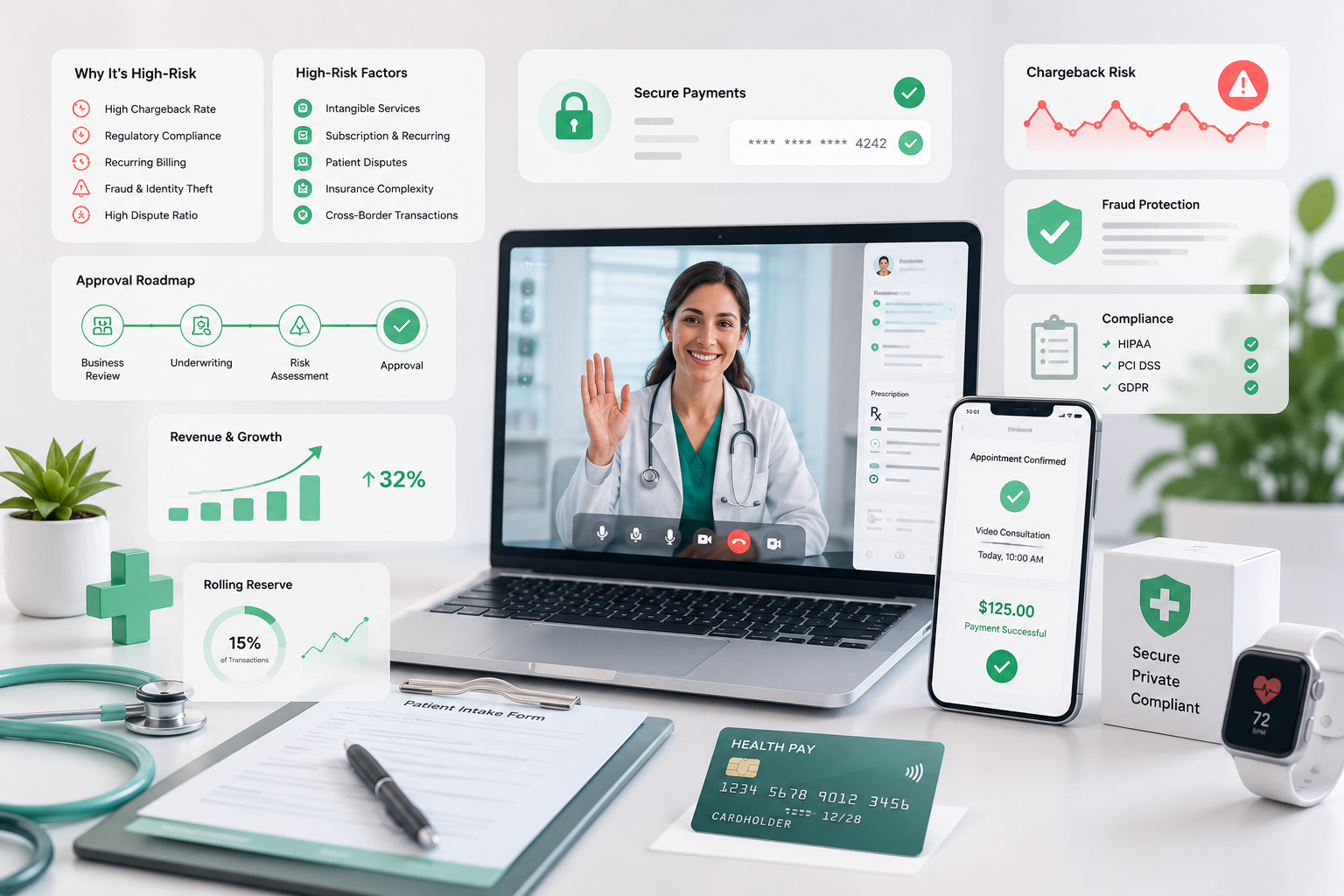
1. Why Telemedicine Is Classified as High-Risk in 2026
In 2026, telemedicine is no longer a niche alternative to in-person care, it is a core pillar of global healthcare delivery. Patients expect virtual consultations, subscription wellness plans, remote prescription management, and on-demand mental health support. The global telehealth market has grown exponentially since 2020, and that growth shows no sign of reversing.
Yet for the telemedicine businesses powering this transformation, one persistent challenge undermines operational stability more than almost any other: securing reliable payment processing infrastructure.
Traditional payment processors often classify telemedicine as high-risk due to higher chargeback potential, complex regulations, remote service delivery, and strict compliance requirements. Many providers face account declines, lengthy underwriting delays, frozen funds, or sudden shutdowns.
The classification is not a commentary on the legitimacy or quality of telemedicine services. It is a consequence of how the industry's business model interacts with the risk frameworks that acquiring banks use to evaluate merchant accounts. Understanding exactly why this classification is applied, and what it means for your payment infrastructure decisions, is the starting point for building a processing setup that supports long-term growth rather than constraining it.
2. The Six Core Risk Factors That Banks Cannot Ignore
Telemedicine sits at the intersection of healthcare, payments, and regulation, a combination that places it in a higher risk category for banks and card networks, even when the business is fully compliant and professionally operated.
1. Intangible Service Delivery
Businesses that provide consultations instead of tangible goods run a greater risk of receiving chargebacks. This is because the merchant is typically unable to prove that the service provided was in line with what was promised to the customer, or the patient in the case of telemedicine. A physical product can be tracked, returned, or photographed. A telehealth consultation cannot be reversed or physically verified, which makes dispute resolution inherently more subjective and chargebacks more likely.
2. Card-Not-Present Transactions Across All Channels
Most telemedicine and telehealth merchants process payments either online or over the phone, meaning the card cannot be visually verified by the merchant. While safeguards are usually in place to prevent fraud and misuse, criminals have found ways around these, and unfortunately merchants are at a greater risk for processing fraudulent transactions. Every telemedicine payment is a CNP transaction, and CNP transactions generate structurally higher fraud and chargeback rates than card-present equivalents.
3. Recurring and Subscription Billing Complexity
Many telemedicine providers charge monthly fees for access, ongoing care, or prescription management. Subscription-style billing increases cancellation disputes and refund requests, especially when patients forget they enrolled or misunderstand the terms. Subscription billing is one of the highest chargeback-generating payment structures across all industries, and in telemedicine, where patients are often emotionally vulnerable or confused about their billing terms, the dispute rate is particularly elevated.
4. Seasonal and Irregular Volume Spikes
Telehealth and telemedicine providers are often busiest at times when mental or physical health are at their worst for the general public, during high-stress times such as Christmas, flu season, and during pandemics and epidemics while the general public is fearful or unable to go out in public. During these times, a higher volume of transactions is processed by these merchants while at slower times, fewer transactions are processed. These irregularities are concerning to payment processors.
5. Delayed Service Delivery Risk
Consultations, prescriptions, follow-ups, and treatment plans can happen days or weeks after the initial charge. When expectations do not match outcomes, disputes and chargebacks are more likely. The gap between payment collection and service completion, particularly for subscription and advance-payment models, creates a window of chargeback exposure that standard processors are not designed to manage.
6. Regulatory Complexity Across Jurisdictions
Telemedicine must follow strict rules around patient consent, disclosures, data protection, and medical oversight. General payment processors are rarely equipped to evaluate these requirements properly, which leads to approvals followed by sudden reviews and account shutdowns. Cross-state telehealth operations in the U.S., GDPR-aligned requirements in the UK, and varying provincial regulations in Canada all create compliance layers that standard processors cannot evaluate accurately during underwriting.
3. HIPAA, LegitScript & MCC Classification: The Compliance Triangle
For telemedicine operators, three compliance frameworks intersect with payment processing in ways that directly affect which processors will work with you, and on what terms.
HIPAA Compliance
Any payment processor that handles Protected Health Information (PHI), including patient names connected to transaction records, medical service descriptions in billing data, or health condition information embedded in payment flows, must operate under a HIPAA-compliant infrastructure. This requires a Business Associate Agreement (BAA) with your processor and documented data security controls that align with HIPAA's Privacy and Security Rules.
As regulatory oversight tightens, payment processing increasingly functions as an extension of healthcare compliance rather than a purely financial utility. Processors that cannot provide a BAA or cannot demonstrate HIPAA-aligned data handling are not viable partners for telemedicine businesses, regardless of their rate or approval speed claims.
LegitScript Certification
LegitScript is an independent certification that verifies the regulatory compliance of online healthcare and pharmaceutical merchants. It is widely recognized by acquiring banks as a trust signal for telemedicine operators, particularly those offering prescription management, weight loss medications, hormone therapy, or any service adjacent to controlled substances.
Corepay's LegitScript partnership allows telemedicine startups to get LegitScript approved in as little as 3–4 weeks. Not every telemedicine provider requires LegitScript certification, general telehealth consultation platforms often do not, but those offering prescription-adjacent services will find it materially improves underwriting outcomes and should pursue certification before applying for a high-risk merchant account.
MCC Classification
Eligibility depends in part on correct Merchant Category Code (MCC) classification and transaction structuring. For example, businesses classified under MCC 8099 (Medical Services) are often better positioned for HSA/FSA acceptance than those categorized under MCC 5912 (Drug Stores and Pharmacies), depending on how services and products are bundled. In practice, some operators benefit from maintaining multiple merchant accounts, separating professional medical services from product fulfillment to align with tax-advantaged payment rules.
Getting your MCC classification right is not just a compliance formality, it directly affects which payment methods you can accept, whether HSA/FSA cards process correctly for your patients, and how acquiring banks categorize your risk level at underwriting.
4. Telemedicine Sub-Verticals and Their Risk Profiles
The telemedicine industry is not a single uniform risk category. Different service models carry meaningfully different risk profiles, and the right high-risk merchant account provider varies accordingly.
Sub-Vertical
Primary Risk Factor
Risk Level
Key Compliance Requirement
General telehealth consultations
CNP fraud, service delivery disputes
Moderate-High
HIPAA BAA, state medical license
Mental health & therapy platforms
Subscription chargebacks, sensitive billing
High
HIPAA BAA, therapist licensing
Weight loss & hormone therapy (TRT, GLP-1)
Regulatory scrutiny, FTC advertising rules
Very High
LegitScript, prescription compliance
Online pharmacy & prescription management
Controlled substance regulation
Very High
DEA registration, LegitScript, state pharmacy license
Concierge / membership-based care
Recurring billing disputes
High
HIPAA BAA, cancellation policy compliance
Nutritionists & wellness coaches
Unregulated advisory claims, fraud
Moderate
Service description accuracy
Remote physical & occupational therapy
Pre-payment risk, insurance complexity
Moderate-High
Provider credentialing, state licensure
Mental health SaaS platforms
B2B subscription disputes, data liability
High
HIPAA BAA, SOC 2 compliance
5. Why Standard Payment Gateways Fail Telemedicine Providers
The instinct for many new telemedicine businesses is to begin with a mainstream payment gateway provider, Stripe, Square, or PayPal, because of their speed, simplicity, and developer-friendly APIs. This is one of the most costly operational mistakes a telehealth operator can make.
Many telehealth companies and pharmacy-adjacent businesses initially rely on payment facilitators or aggregator platforms, often embedded within e-commerce, electronic health records (EHRs), or pharmacy management software. Although these solutions offer rapid onboarding, they also place merchants under a master merchant account controlled by the platform rather than the business itself.
The consequences of this dependency become apparent quickly:
- Automated risk flagging: Aggregators use automated systems that flag telemedicine MCCs and trigger account reviews without human review of your actual compliance status or business model.
- Frozen funds at critical moments: A volume spike during flu season, exactly when your revenue should be highest, can trigger an automated hold that freezes patient billing for days or weeks.
- No healthcare-specific support: When a HIPAA-related dispute arises or a state licensing question affects your processing, aggregator support teams have no healthcare compliance knowledge and cannot help.
- No BAA available: Major payment aggregators do not offer Business Associate Agreements for telemedicine merchants, making their use with PHI-connected billing a potential HIPAA violation.
High-risk merchants such as TailoredPay are built to handle delayed fulfillment, recurring payments, higher dispute exposure, and regulatory oversight from the start. For telemedicine providers, that means stable payment processing, predictable payouts, and far less risk of frozen funds as the business grows.
6. What to Look for in a High-Risk Payment Gateway Provider
When evaluating a payment gateway provider for your telemedicine operation, the following capabilities should be non-negotiable in 2026:
HIPAA-Compliant Infrastructure with BAA
Your payment gateway must support a signed Business Associate Agreement and maintain documented HIPAA-aligned data security controls. This is a legal requirement for any processor handling PHI, not optional best practice.
Subscription and Recurring Billing Support
Telehealth subscription billing requires a gateway with configurable recurring billing logic, automated retry on failed payments, flexible cancellation workflows, and clear billing descriptor management. A gateway that handles recurring billing badly generates chargebacks that a specialty-focused payment gateway designed for healthcare would prevent.
Real-Time Chargeback Management
Look for integration with Verifi and Ethoca pre-dispute alert services, along with built-in chargeback monitoring dashboards that provide ratio visibility at the account level. For telemedicine providers, catching a dispute before it becomes a formal chargeback can mean the difference between account stability and a chargeback ratio breach.
HSA/FSA Card Acceptance
Patients increasingly prefer to use HSA and FSA funds for telehealth consultations. A high-risk payment gateway provider that supports HSA/FSA acceptance alongside standard credit and debit cards expands your patient payment options and reduces friction at billing a, meaningful competitive advantage in the telehealth market.
EHR, EMR & Scheduling System Integration
Your payment processing infrastructure must integrate cleanly with your existing clinical workflow tools. Disconnected payment systems that require manual reconciliation create billing errors, patient dissatisfaction, and administrative overhead that compounds at scale.
LegitScript Partnership
For prescription-adjacent telemedicine providers, a high-risk merchant account provider with an established LegitScript partnership, and experience guiding providers through the certification process, is strongly preferable to one without.
Dedicated Healthcare Account Management
Telemedicine billing disputes, licensing questions, and compliance reviews require account managers with healthcare payment expertise. A generic account manager unfamiliar with HIPAA, state medical licensing, or telehealth billing models cannot provide the support your business needs when problems arise.
7. Best High-Risk Merchant Account Providers for Telemedicine in 2026
The following high-risk merchant account provider options have demonstrated specialized expertise in telemedicine and digital health payment processing in 2026:
PaymentCloud: Widely recognized as the strongest overall high-risk merchant account option for telemedicine. PaymentCloud is the only major provider offering support for high-risk businesses in the healthcare space. Although it may have a slightly longer approval process than other providers, PaymentCloud has a very high 98% merchant approval rate. It can work with any payment gateway and tailor custom solutions based on your needs, including any EHR, EMR, or PMS platform. One of the best things about PaymentCloud is you will get a dedicated account manager from the start.
Corepay: Strong telemedicine specialist with LegitScript partnership support. Corepay offers customized payment processing designed to meet the unique needs of telemedicine providers, including support for high-risk billing. Ensures patient confidentiality with HIPAA-compliant systems, PCI compliance, and state-of-the-art fraud prevention tools. Their CB-ALERT chargeback management tool is particularly well-suited to telemedicine's dispute exposure profile.
PayKings: Telemedicine-specific underwriting with subscription billing capability. PayKings provides specialized merchant account solutions designed specifically for telemedicine providers, including HIPAA-compliant processing, subscription billing capabilities, integrated payment platforms, and comprehensive reporting tools.
Seamless Chex: Strong option for telemedicine platforms requiring subscription billing redundancy and HIPAA compliance. The Seamless Chex platform is built for high-risk and growth-focused industries, with flexible payment solutions with subscription and recurrent billing support, HIPAA compliance, and a team that supports merchants every step of the way. No volume limitations, suitable for rapidly scaling telehealth platforms.
TailoredPay: Designed specifically for telemedicine providers with delayed fulfillment models. Particularly strong for subscription care, advance-pay consultation, and bundled service billing with the recurring payment complexity those models generate.
2Accept: Specialist in high-risk healthcare with approval logic built for licensed healthcare providers. The human onboarding team is familiar with HIPAA and HITECH standards. Supports virtual terminal and link-based payments for non-contact billing, with transparent reserves and fee structures explained upfront.
Organic Payment Gateways: Strong for prescription-adjacent telehealth including online pharmacies and telehealth providers who offer treatments for weight loss and diabetes management, including facilitating secure, high-risk payment processing for peptide-based medications like semaglutide and tirzepatide.
8. Real Fees & Reserve Terms for Telemedicine Merchants
Understanding the realistic cost structure for a telemedicine high-risk merchant account prevents unpleasant surprises post-approval.
Fee Type
Typical Range
Telemedicine Notes
Transaction Rate
3.5% – 6.5%
Higher for prescription-adjacent services
Monthly Account Fee
$25 – $100
Standard across high-risk verticals
Chargeback Fee
$25 – $75 per dispute
Subscription-model providers face elevated frequency
Rolling Reserve
5% – 15% for 90–180 days
Reduces with 6+ months of clean chargeback history
Payment Gateway Fee
$15 – $50/month
Separate from processing in most telemedicine setups
PCI Compliance Fee
$5 – $20/month
Ensure it reflects active compliance, not a passive charge
HIPAA BAA
Usually $0 with specialized processors
Standard aggregators do not offer this
LegitScript Certification
$200–$500 annual
Required for prescription-adjacent providers
A telemedicine business processing $75,000/month at a 10% rolling reserve held for 90 days carries approximately $22,500 in working capital tied to the reserve at steady state. Factor this into cash flow planning before finalizing your processing arrangement.
9. How to Get Approved: Documents & Strategies
A telemedicine merchant account can be set up by starting with a streamlined application process designed for telemedicine providers, providing required documentation including medical licenses and compliance certificates, working with a specialized team who guides you through the setup process ensuring healthcare compliance, and then beginning to accept secure payments for your virtual healthcare services. https://thefinrate.com/telemedicine-digital-health-high-risk-payment-processing-guide-2026/


Comments
Post a Comment