Payment Reserve Negotiation: How to Lower Your Rolling Reserve as a High-Risk Merchant
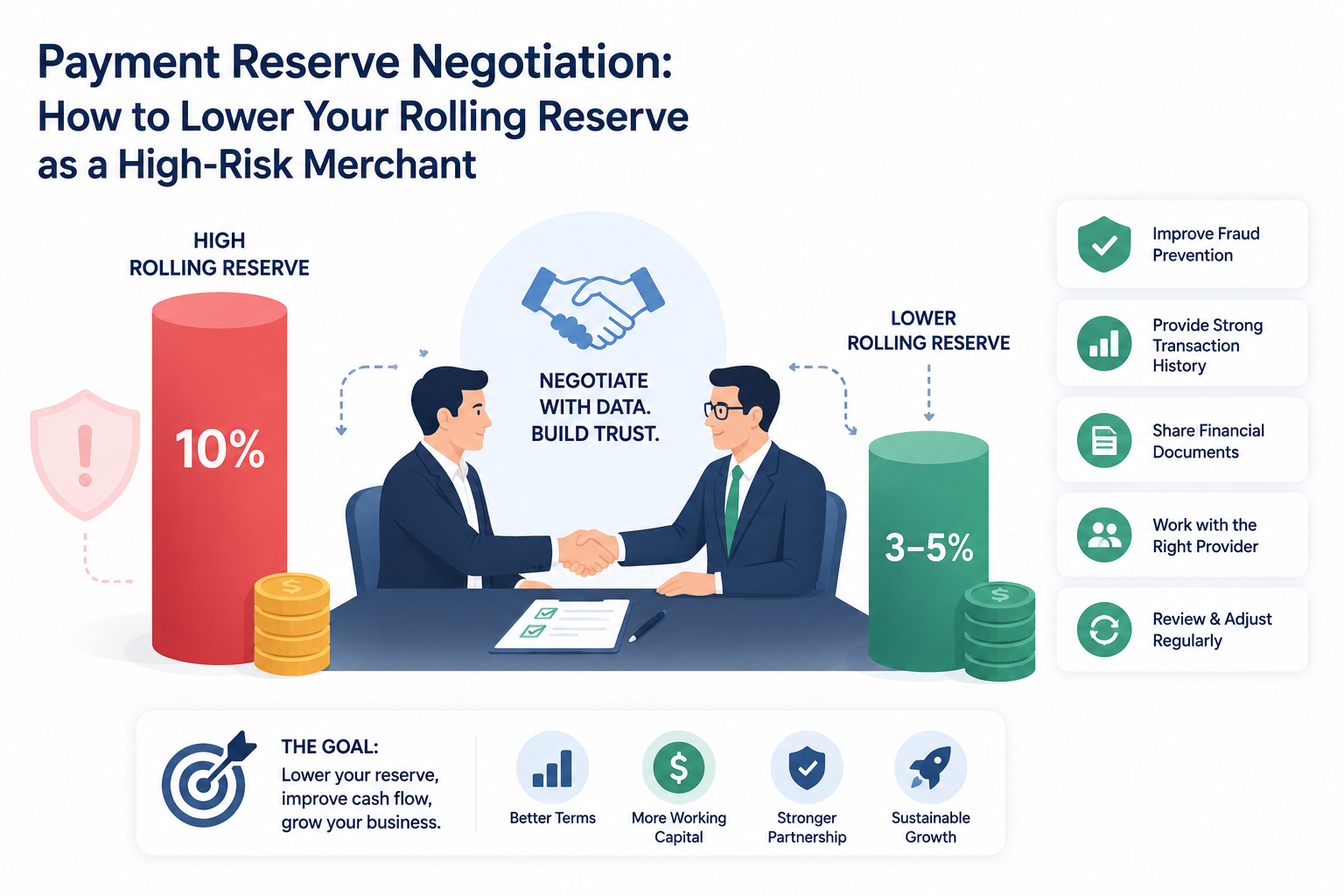
If you are a high-risk merchant, you already know what a rolling reserve feels like. Every month, a chunk of your revenue gets locked away by your payment processor, held for 90, 120, sometimes 180 days, and you have no access to it. It sits there while your business needs it for marketing, operations, inventory, and growth.
For some merchants, the rolling reserve is just an inconvenience. For others, particularly fast-growing businesses with thin cash margins, it becomes a genuine growth bottleneck. A business processing $300,000 per month at a 10% rolling reserve on a 90-day hold has $90,000 frozen at any given time. Scale that to $1 million per month and you have $300,000 in locked capital.
The good news is that rolling reserves are not fixed. They are negotiable, and most processors expect merchants to push back once they have earned the right to do so.
This guide will teach you exactly how to do that.
What Is a Rolling Reserve and Why Do Processors Use It?
Before you can negotiate effectively, you need to understand what you are negotiating and why the other party cares about it.
A rolling reserve is a risk management tool. When a processor onboards a high-risk merchant, they are taking on financial liability. If your customers file chargebacks after you have already been paid out, the processor has to cover those losses, and then recover the money from you. If you cannot pay, they absorb the loss.
The rolling reserve is their protection against that scenario. By withholding a percentage of your daily or monthly settlements, typically 5% to 15% for high-risk merchants, and holding it for a defined period (most commonly 90 to 180 days), they build a buffer that covers potential chargeback losses even if your account is suddenly terminated.
From the processor's perspective, the reserve is not punitive. It is insurance. Understanding this reframes the negotiation: you are not asking them to take a risk on you out of goodwill. You are showing them evidence that the risk they are insuring against has decreased, and therefore the insurance premium should be lower.
The Three Types of Merchant Reserves You Should Know
Not all reserves work the same way, and knowing the differences gives you more negotiation options beyond simply asking for a lower percentage.
Rolling Reserve
This is the most common type for high-risk merchants. A fixed percentagesay ,10%, is withheld from every settlement. After the hold period expires (say 90 days), the withheld funds from that period are released on a rolling basis. So the reserve is always in motion: new funds being withheld, old funds being released.
The challenge with rolling reserves is that they scale with your volume. As your business grows, more capital gets locked up proportionally, which is exactly when you need that capital most.
Capped Reserve
A capped reserve works differently. Instead of withholding a percentage of every transaction indefinitely, the processor withholds funds until a fixed maximum amount is reached, for example, $50,000. Once that cap is hit, no further funds are withheld. Existing funds are still held for the defined period, but the drain on your cash flow stops once the reserve is fully funded.
This is significantly more cash-flow-friendly for growing businesses and is one of the most valuable things you can negotiate for.
Upfront Reserve
An upfront reserve requires you to deposit a lump sum, usually equivalent to one to three months of projected chargeback exposure, before the processor will activate your account. It is more common during onboarding than during ongoing processing. While it requires initial capital, it eliminates the ongoing deduction from settlements, which can actually improve cash flow for established businesses.
When negotiating, your goal is not always just to lower the percentage. Sometimes switching from a rolling reserve to a capped or upfront reserve is a better outcome for your business even if the total reserve amount stays the same.
When Is the Right Time to Negotiate Your Reserve?
Timing matters enormously in reserve negotiations. Walking into a negotiation at the wrong moment, when your chargeback ratio is elevated, when you have just had a volume spike, or when you are only a few months into a new processing relationship, will almost certainly fail.
The right time to open a renegotiation conversation is when you have a clear track record of low-risk behavior. As a general rule, you should have at least six consecutive months of processing history with the processor before requesting a reserve review, a chargeback ratio consistently below 0.75% during that period (below 0.5% puts you in a very strong position), no fraud flags, no compliance issues, and no history of unexplained volume spikes.
If you are approaching a processor for the first time during onboarding, you have limited negotiating power unless you can bring documented processing history from a previous processor showing the same track record. In that case, historical statements and chargeback reports become your negotiating chips.
How to Build Your Negotiation Case: The Evidence Package
Reserve negotiations are won or lost on evidence. Processors are not going to reduce your reserve because you asked nicely or because you explained that the reserve is hurting your cash flow. They will reduce it when you make a compelling, documented case that the risk justifying the reserve has decreased.
Here is what to compile before you open the conversation.
Six Months of Chargeback Reports
Pull your monthly chargeback ratio reports for the past six months. If they consistently show ratios below 0.75%, this is your single strongest piece of evidence. Highlight the trend, ideally showing improvement over time, not just stability. If your ratio has dropped from 1.2% eighteen months ago to 0.4% today, that trajectory tells a powerful story.
Refund Rate Data
Chargebacks measure disputes that escalated to the bank. Your refund rate measures disputes you resolved proactively, customers who got their money back without involving the bank. A high refund rate alongside a low chargeback rate shows processors that you handle customer complaints at the source rather than letting them escalate. This is exactly the behavior they want to reward.
Fraud Screening Documentation
Provide evidence of your fraud prevention infrastructure. This includes the fraud screening tools you use (such as 3D Secure, device fingerprinting, address verification, velocity checks), the fraud rejection rate on your transactions, and any fraud management certifications or audits you have completed. The more robust your fraud stack, the lower the processor's residual risk.
Financial Statements
Current financial statements, ideally audited or at minimum reviewed by an accountant, demonstrate that your business can absorb chargeback losses without becoming insolvent. If your cash position is strong and your business is profitable, processors are far more comfortable reducing the reserve because you represent a lower recovery risk.
Compliance Documentation
Gather your PCI DSS compliance certificates, KYC program documentation, AML policy, Terms of Service, and any relevant regulatory licenses (FCA authorization in the UK, state gaming licenses in the USA, FINTRAC registration in Canada). Compliance documentation signals to the processor that your risk profile is actively managed rather than ignored.
Volume Growth Forecast
If your processing volume has grown significantly and is projected to continue growing, include a volume forecast. Processors earn fees on volume, a growing merchant is a more valuable merchant. Framing the reserve reduction as enabling further growth (and therefore higher fees for the processor) aligns your interest with theirs.
The Negotiation Conversation: What to Say and How to Say It
Once your evidence package is ready, request a formal account review meeting, not just an email exchange. A phone or video call gives you the ability to read the conversation, address objections in real time, and demonstrate professionalism.
Start by acknowledging the relationship and the processor's perspective. Something like: "We have been processing with you for 14 months. We value the relationship and want to grow our volume through your platform. We would like to discuss our reserve terms, which we believe no longer reflect our current risk profile."
Then walk through your evidence. Present the chargeback data first, it is their primary concern. Follow with fraud screening, financial stability, and compliance. Let the numbers make the argument before you make the ask.
When you make the ask, be specific. Do not say "we would like a lower reserve." Say "based on our 0.4% average chargeback ratio over the past six months and our audited financials, we are requesting a reduction from a 10% rolling reserve to a 5% capped reserve, with a cap of $75,000." A specific, justified ask is far harder to dismiss than a vague one.
Be prepared for a counteroffer. Processors rarely give you exactly what you ask for in the first conversation. If they offer a partial reduction, say from 10% to 7% rolling, accept it, execute for another three to four months, and reopen the conversation. Incremental wins compound over time.
Reserve Negotiation Strategies by Market
The mechanics of reserve negotiation vary across the four key markets that TheFinrate covers. Understanding the local context helps you approach the conversation with realistic expectations.
United States
US-based high-risk merchants typically work with ISO/MSPs rather than directly with acquiring banks. In this structure, the ISO sets the reserve terms, and the acquiring bank behind the ISO sets the floor. Your negotiation is with the ISO, but their ability to reduce reserves is constrained by what the acquiring bank allows. When negotiating in the US market, ask explicitly whether the reserve terms are set by the ISO or the acquiring bank, this tells you how much flexibility actually exists. If the ISO has no flexibility, it may be worth requesting an introduction to an alternative acquiring bank within the same ISO's network.
United Kingdom
The UK has a more structured regulatory environment, and FCA-regulated merchants have meaningfully more negotiating leverage with processors. FCA authorization signals to processors that your business has already passed rigorous compliance scrutiny, which directly reduces the regulatory risk component of your reserve calculation. If you are FCA-authorized and your chargeback performance is strong, use both as primary negotiating points. UK processors also tend to respond well to formal, documented proposals rather than informal conversations, putting your case in writing as a professional document before the meeting tends to produce better outcomes.
Latin America
Reserve negotiations in LATAM are more complex because many high-risk merchants in this region process cross-border, meaning they work with offshore processors who apply international risk standards rather than local ones. Approval rates, currency exchange exposure, and local regulatory uncertainty all factor into reserve calculations beyond just chargebacks. To negotiate successfully in LATAM, the most effective move is to shift to local acquiring in key markets, particularly Brazil, Mexico, and Colombia. Local processors have lower risk perceptions for locally-licensed businesses, and local acquiring typically comes with lower reserve requirements than cross-border processing as a baseline.
Canada
Canadian banks are conservative by nature, and high-risk merchants often struggle to negotiate reserves with domestic processors who are simply unwilling to budge. If you have hit a wall with a Canadian processor, the pragmatic approach is to work with a US-based or UK-based processor for the majority of your Canadian volume. These processors are more experienced with high-risk accounts and have more established reserve negotiation frameworks. Interac e-Transfer volume, which carries significantly lower chargeback exposure than credit card processing, can also be used as a negotiating point, demonstrating that a portion of your transaction mix is inherently lower risk brings down the composite risk profile of your account.
Common Mistakes That Kill Reserve Negotiations
Even merchants with strong chargeback performance and solid evidence packages sabotage their own negotiations. These are the most common mistakes to avoid.
Negotiating from desperation: If you open the conversation by explaining how badly the reserve is hurting your cash flow, you are signaling financial vulnerability, exactly the opposite of what you want to communicate. Always frame the negotiation around your reduced risk profile, not your financial need.
Asking without evidence: A verbal request for a lower reserve with no supporting data will almost always result in a polite refusal. Your processor needs to justify the reserve change internally, and they cannot do that without documentation.
Negotiating too early: Asking for a reserve reduction after three months of processing, even with a perfect chargeback record, rarely works. Processors need to see a sustained pattern, not a short-term streak.
Accepting the first response as final: Many processors expect merchants to accept their terms without pushback. A polite, professional counter-response that reiterates your evidence and refines your ask is often enough to move the conversation forward.
Ignoring the relationship dimension: Reserve negotiations happen between people, not just organizations. Your account manager, if you have one, is an ally in this process, they want to retain your business. Build that relationship proactively, not just when you need something.
What to Do If Your Processor Refuses to Negotiate
Some processors will not reduce reserves regardless of your performance. This happens for a few reasons: the acquiring bank behind them has rigid risk policies, your vertical is subject to blanket reserve requirements that apply to all merchants in that category, or the processor simply does not have the infrastructure to handle individual reserve reviews.
If you have made a strong, evidence-backed case and the answer is still no, your options are to continue with current terms and revisit in another six months, request a transfer to a different acquiring bank within the same processor's network, or approach a competing processor with your evidence package and use their offer as leverage in a renegotiation conversation.
Shopping your account, getting a competing offer from another processor, is one of the most effective negotiation tools available. When your current processor sees that a competitor is willing to offer better terms for your business, the conversation about reserve reduction tends to move much faster.
Final Thoughts: The Reserve Is a Negotiation, Not a Sentence
Rolling reserves are a cost of doing business as a high-risk merchant, but they are a cost with a variable rate, not a fixed one. The merchants who pay the most are the ones who never push back. The merchants who pay the least are the ones who treat reserve terms as an ongoing negotiation rather than a one-time agreement signed during onboarding.
Build your evidence. Know what you are asking for and why. Pick the right moment. Present your case professionally. And if the answer is no today, build toward a yes six months from now.
Your reserve rate reflects your processor's perception of your risk. Change the perception, with performance, documentation, and consistent communication, and the rate will follow.
Frequently Asked Questions
What is a typical rolling reserve rate for high-risk merchants?
Rolling reserves for high-risk merchants typically range from 5% to 15% of transaction volume, held for 90 to 180 days. The exact rate depends on your industry, chargeback history, processing volume, and the specific processor. Merchants with strong performance records can often negotiate rates down to 3–5%.
How long does it take to get a rolling reserve reduced?
Most successful negotiations happen after six to twelve months of consistent low-chargeback processing. The timeline depends on how strong your track record is and how willing your processor is to negotiate. Expect the process to take one to three months from the initial conversation to a formal reserve adjustment.
Can I negotiate my reserve during onboarding?
Yes, but your leverage is limited if you have no prior processing history. The best approach during onboarding is to bring documented statements from a previous processor showing strong performance. Without that, most processors will apply their standard reserve terms and expect a review after six months of processing.
What is the difference between a rolling reserve and a capped reserve?
A rolling reserve withholds a percentage of every transaction indefinitely, scaling with your volume. A capped reserve withholds funds until a fixed maximum amount is reached, then stops. For growing businesses, a capped reserve is almost always better for cash flow because the drain stops once the reserve is fully funded.
Is it worth switching processors just to get a lower reserve?
Switching processors has real costs, integration time, potential processing downtime, and starting a new relationship from scratch with no processing history. Before switching, make sure you have exhausted negotiation options with your current processor and that the reserve savings genuinely outweigh the switching costs. That said, getting a competing offer is a very effective negotiation tool even if you have no intention of switching.
Does reserve negotiation work for all high-risk industries?
Most high-risk industries have negotiable reserves, but some verticals, particularly those facing blanket policies from acquiring banks, such as certain gambling categories or crypto in specific jurisdictions, have less flexibility. In those cases, the more effective strategy is often switching to a processor with a more favorable approach to your vertical rather than negotiating with one that has a structural ceiling on what they can offer. https://thefinrate.com/payment-reserve-negotiation-how-to-lower-your-rolling-reserve-as-a-high-risk-merchant/


Comments
Post a Comment