Payment Orchestration Platforms for High-Risk Merchants: Top Solutions Compared
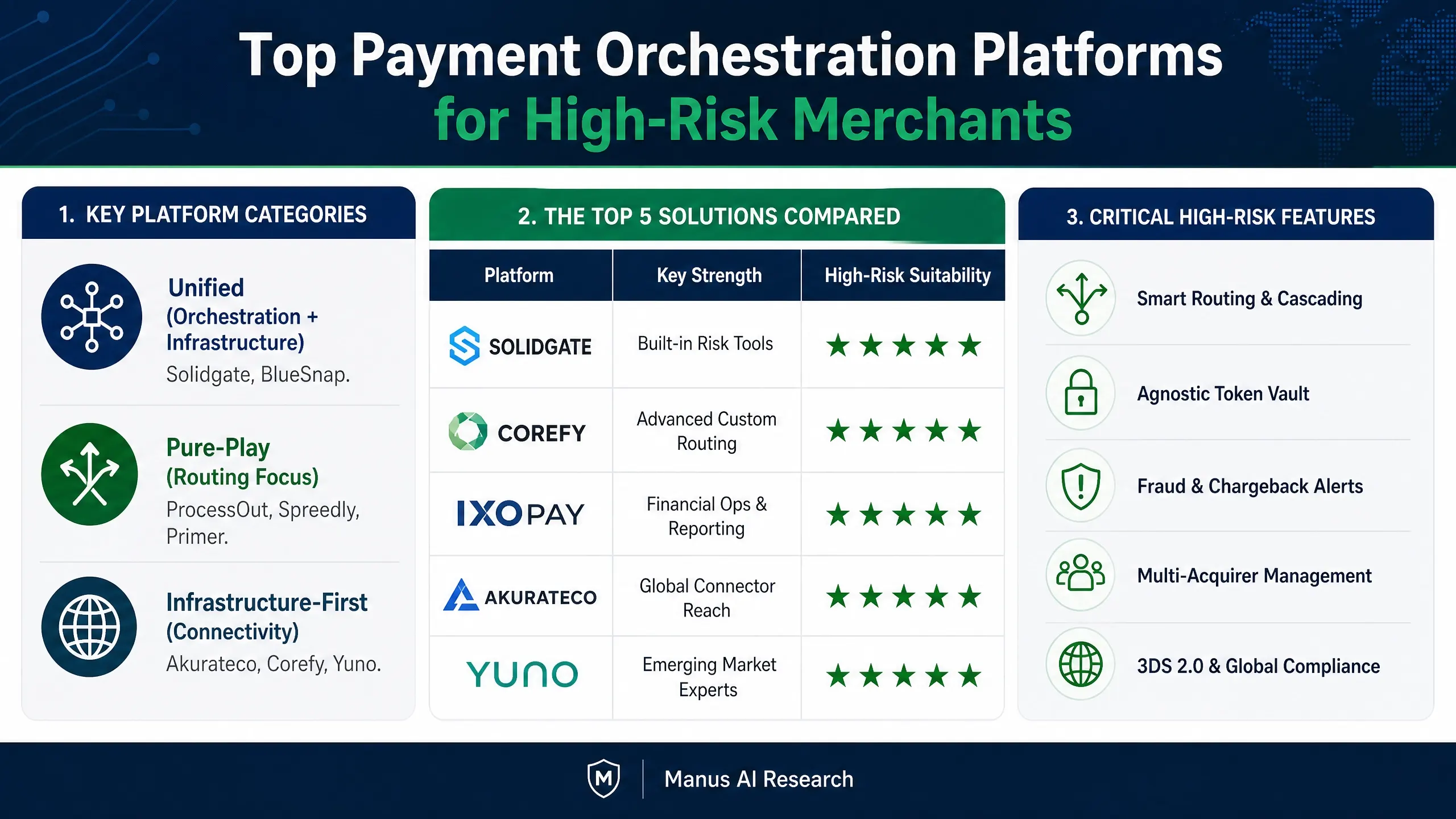
TL;DR: Payment orchestration platforms sit above your payment gateways and route transactions intelligently across multiple acquirers and payment providers, maximising approval rates, minimising downtime, and reducing dependency on any single processor. For high-risk merchants, where a single gateway failure or merchant account termination can halt all revenue, orchestration is no longer optional infrastructure, it's a survival strategy.
A single payment gateway going down, a single merchant account being terminated, or a single acquirer raising reserves can halt revenue overnight for a high-risk merchant. Payment orchestration platforms solve this by sitting above your entire processing stack and routing transactions dynamically, across multiple acquirers, multiple payment providers, and multiple geographies, in real time.
The global payment orchestration market is projected to reach $3.79 billion by 2026 (Grand View Research), driven largely by high-risk and enterprise merchants who have learned the hard way what single-provider dependency costs. This comparison covers the top platforms in 2026 and how to choose the right one for your vertical.
What Is a Payment Orchestration Platform?
A payment orchestration platform, sometimes called a payment operations layer or smart routing layer, is a middleware solution that connects a merchant to multiple payment gateways, acquirers, and payment providers through a single API integration. Rather than processing all transactions through one gateway, the orchestration layer evaluates each transaction in real time and routes it to the optimal processor based on configurable rules.
Core Functions of a Payment Orchestration Platform
- Smart routing: Directs transactions to the acquirer most likely to approve them based on card type, geography, transaction value, and real-time approval rates
- Failover routing: Automatically reroutes failed transactions to a backup payment gateway without the customer experiencing a decline
- Load balancing: Distributes transaction volume across multiple acquirers to manage chargeback ratios and reserve exposure
- Unified reporting: Consolidates performance data from all connected payment providers into a single dashboard
- TokenisationL: Stores card data centrally so that routing changes are invisible to returning customers
- Currency and method management: Enables multi-currency payment processing and alternative payment method routing from a single integration
Why High-Risk Merchants Need Orchestration More Than Anyone
Standard merchants can survive a gateway outage or acquirer issue with limited disruption. For high-risk merchants, the stakes are structurally higher:
- Merchant account termination: is more frequent, a single debanking event without a backup route means zero revenue
- Chargeback ratio management: requires distributing volume across acquirers, impossible without an orchestration layer
- Approval rate optimisation: is critical, high-risk transactions are declined more frequently, and smart routing to the right acquirer per card type recovers meaningful revenue
- Offshore merchants: processing across multiple jurisdictions need multi-acquirer routing to match card origin to the optimal local acquirer
- Reserve management: spreading volume across acquirers limits rolling reserve accumulation with any single provider
Quick Comparison: Top Payment Orchestration Platforms for High-Risk Merchants (2026)
Platform
Best For
Acquirer Integrations
Smart Routing
High-Risk Experience
Pricing Model
Spreedly
Multi-gateway flexibility
130+
✅ Advanced
✅ Strong
Transaction % + monthly fee
Paydock
Modular orchestration
80+
✅ Advanced
✅ Good
SaaS monthly + transaction
Gr4vy
Developer-first orchestration
100+
✅ Advanced
✅ Strong
SaaS monthly
Corefy
High-risk & offshore focus
400+
✅ Advanced
✅ Excellent
Transaction-based
Zooz (PayU)
Enterprise scale
50+
✅ Standard
⚠️ Moderate
Enterprise pricing
Akurateco
High-risk specialisation
300+
✅ Advanced
✅ Excellent
Setup fee + transaction %
Primer
No-code workflow automation
60+
✅ Advanced
⚠️ Moderate
SaaS + transaction
Top Payment Orchestration Platforms: In-Depth Reviews
1. Spreedly - Best for Maximum Gateway Flexibility
Spreedly is one of the most established orchestration platforms in the market, offering connections to over 130 payment gateways and acquirers globally through a single vault and API. Its strength lies in breadth, merchants can connect virtually any payment provider without re-integrating card data, making it a strong choice for high-risk merchants who need to move between acquirers frequently.
Key Features
- Universal card vault with PCI-compliant tokenisation across all connected gateways
- Advanced transaction routing with customisable rule sets
- Real-time failover routing when primary gateway declines or errors
- Strong developer documentation and sandbox environment
- Supports alternative payment processing methods alongside card routing
Pricing
- Monthly platform fee starting from approximately $1,500
- Per-transaction fee on top (varies by volume)
- Custom enterprise pricing for high-volume high-risk merchants
Pros
- Largest gateway integration library in the market, maximum acquirer optionality
- Vault-first architecture means switching acquirers doesn't require recollecting card data
- Strong track record with high-risk verticals including subscription billing and digital goods
- Excellent API documentation, low developer integration overhead
Cons
- Not purpose-built for high-risk, some high-risk-specific features require third-party add-ons
- Pricing becomes significant at lower processing volumes
- Less built-in chargeback management tooling than specialist platforms
Best For: High-risk merchants that need maximum acquirer optionality and have strong internal technical resources.
2. Corefy - Best Overall for High-Risk and Offshore Merchants
Corefy is a payment orchestration platform specifically built with complex, high-risk, and offshore merchant use cases in mind. With over 400 payment provider integrations, including regional acquirers, alternative payment methods, and crypto processors, it offers the broadest connectivity of any platform in this comparison, paired with advanced routing logic designed for high-risk transaction profiles.
Key Features
- 400+ integrations including high-risk specialist acquirers rarely available on mainstream platforms
- Cascade routing, automatically retries declined transactions through a configurable sequence of providers
- Built-in chargeback management and dispute tracking across connected acquirers
- Multi-currency and multi-entity support, purpose-built for offshore merchants with complex corporate structures
- White-label options for payment providers building orchestration into their own merchant services
Pricing
- Transaction-based pricing, percentage of processed volume, scaling down with volume
- No fixed monthly minimum at entry level
- Custom enterprise agreements for high-volume processing
Pros
- Best-in-class acquirer breadth for high-risk verticals, covers gambling, adult, forex, nutraceuticals
- Cascade routing is the most effective tool for recovering declines in high-risk transaction environments
- Built-in analytics with chargeback ratio monitoring across all connected acquirers
- Offshore-friendly architecture, multi-entity, multi-currency, multi-jurisdiction by design
Cons
- Less brand recognition than US-headquartered competitors, may require additional due diligence
- Onboarding complexity increases with the number of connected providers
- Documentation less polished than Spreedly or Gr4vy for developer teams
Best For: High-risk merchants and offshore merchants who need the deepest acquirer coverage and cascade routing capability.
3. Akurateco - Best for High-Risk Specialist Routing
Akurateco positions itself explicitly as a payment orchestration platform for high-risk industries. With over 300 payment provider integrations and a routing engine built specifically around the compliance and approval-rate challenges of high-risk payment processing, it's a strong choice for merchants in gambling, adult, forex, and subscription verticals.
Key Features
- Intelligent routing engine with BIN-level routing logic, routes by card-issuing country, card type, and historical approval rates
- Built-in anti-fraud module with risk scoring across connected payment gateways
- Chargeback monitoring dashboard with ratio tracking across all acquirer relationships
- Recurring billing management with intelligent retry logic for failed payments
- White-label platform available for payment providers and PSPs
Pricing
- One-time setup fee + transaction percentage
- Volume discounts at scale
- Custom pricing for enterprise merchant services requirements
Pros
- Built specifically for high-risk, the routing logic is calibrated for high-risk approval rate patterns
- BIN-level routing recovers significant approval rate improvement in international high-risk processing
- Recurring billing retry logic directly reduces involuntary churn and related dispute exposure
- Strong track record in iGaming, adult, and forex verticals specifically
Cons
- Smaller platform, fewer self-service resources than larger competitors
- Integration quality varies across the 300+ connected providers
- Less suitable for merchants outside the high-risk niche
Best For: Merchants in iGaming, adult content, forex, and subscription billing who want a platform purpose-built around their specific approval-rate and compliance challenges.
4. Gr4vy - Best for Developer-Led Orchestration
Gr4vy (pronounced "gravy") is a cloud-native payment orchestration platform designed for developer teams that want full control over their routing logic through a clean, well-documented API. Its cloud-based architecture deploys in regional infrastructure to minimise latency, a meaningful advantage for high-risk merchants processing internationally.
Key Features
- 100+ payment gateway and acquirer integrations with standardised API
- Visual workflow builder for routing rule configuration, accessible to non-technical teams
- Regional cloud deployment (US, EU, APAC) for low-latency payment processing
- Built-in payment method management supporting cards, wallets, and local payment methods
- Strong tokenisation infrastructure with network tokenisation support
Pricing
- SaaS monthly fee, tiered by transaction volume
- No per-transaction fees at standard tiers
- Enterprise agreements for high-volume processing
Pros
- Cleanest API in the market, lowest developer integration overhead
- Visual routing rules builder enables non-technical teams to manage routing logic
- Regional cloud deployment reduces latency for offshore merchants processing across multiple geographies
- No per-transaction fee model makes cost more predictable at scale
Cons
- Fewer high-risk-specific integrations than Corefy or Akurateco
- Newer platform, less track record in high-risk verticals than established competitors
- Visual workflow builder, while accessible, has limits for very complex routing requirements
Best For: Developer-led high-risk merchants who want maximum API flexibility and clean infrastructure, particularly those processing across US, EU, and APAC simultaneously.
5. Paydock - Best for Modular, Component-Based Orchestration
Paydock takes a modular approach to payment orchestration, merchants select and activate specific components (routing, vaulting, subscriptions, fraud) as needed rather than buying a monolithic platform. This flexibility makes it well-suited to high-risk merchants at different stages of infrastructure maturity.
Key Features
- 80+ payment provider integrations with modular activation
- Subscription and recurring billing engine with dunning management
- Fraud management layer with configurable rule sets across connected payment gateways
- Unified customer payment profile across all connected providers
- Strong Australian and APAC market coverage, useful for offshore merchants with APAC exposure
Pricing
- SaaS monthly fee + per-transaction component pricing
- Modular structure means merchants only pay for activated components
- Volume-based pricing adjustments
Pros
- Modular architecture, cost-effective for merchants who don't need every feature immediately
- Strong subscription management, particularly valuable for recurring billing high-risk merchants
- Good APAC coverage for merchants with Southeast Asian and Australian customer bases
- Clean merchant dashboard with unified reporting across all connected providers
Cons
- Fewer total integrations than Spreedly or Corefy, some niche high-risk acquirers not available
- Modular pricing can become complex to predict as more components are activated
- Less known in high-risk European and US markets
Best For: High-risk merchants with significant recurring billing volume or APAC-focused offshore merchants who want component-level cost control.
Key Features to Evaluate When Choosing a Platform
Not all orchestration platforms are equal for high-risk merchants. Beyond the standard feature checklist, prioritise these criteria specifically:
Acquirer Depth in Your Vertical
General-purpose platforms may list 100+ integrations but have limited coverage of acquirers that actually approve high-risk MCCs. Ask specifically: "Which of your connected acquirers actively approve ?" The answer narrows the field significantly.
Cascade Routing Logic
Cascade routing, automatically retrying a declined transaction through a sequence of alternative acquirers, is the most impactful approval-rate recovery mechanism for high-risk merchants. Not all platforms implement it equally. Evaluate how many cascade levels are configurable and whether retry logic accounts for decline reason codes.
Chargeback Ratio Monitoring
Volume distribution across acquirers is a chargeback management tool, spreading volume prevents any single merchant account from breaching ECP or VAMP thresholds. Does the platform provide real-time ratio monitoring across all connected acquirers in a single dashboard?
Tokenisation Architecture
When you switch acquirers, inevitable for high-risk merchants, you need card data to move with you. A centralised vault with network tokenisation capability means customers' saved cards remain usable regardless of which acquirer you route to. Without this, acquirer changes force re-collection of card data and destroy subscription continuity.
Offshore and Multi-Entity Support
Offshore merchants processing under multiple corporate entities in different jurisdictions need orchestration platforms that support multi-entity configurations, different routing rules, different acquirer relationships, and different settlement currencies under one platform. Confirm explicitly whether the platform supports this before committing.
Pros and Cons of Payment Orchestration for High-Risk Merchants
Pros
- Eliminates single-acquirer dependency, the primary cause of revenue interruption for high-risk businesses
- Smart routing measurably improves approval rates, typically 5–15% uplift on high-risk transaction profiles
- Volume distribution across acquirers enables proactive chargeback ratio management
- Unified reporting replaces fragmented data from multiple payment provider dashboards
- Tokenisation enables acquirer switching without impacting returning customers
- Cascade routing recovers revenue from transactions that would otherwise be permanently declined
Cons
- Additional integration layer increases technical complexity and potential failure points
- Monthly platform costs add to already elevated high-risk payment processing fees
- Not all high-risk acquirers are integrated with mainstream orchestration platforms
- Routing rule management requires ongoing optimisation, not a set-and-forget solution
- Onboarding time, connecting multiple acquirers and configuring routing rules takes weeks, not days
How to Choose the Right Platform: Decision Framework
Your Situation
Recommended Platform
Need maximum acquirer optionality
Spreedly
High-risk / offshore with complex routing needs
Corefy
iGaming, adult, or forex specialist
Akurateco
Developer-led team, clean API priority
Gr4vy
Heavy recurring billing / subscription model
Paydock
Enterprise scale with existing PayU relationship
Zooz (PayU)
Frequently Asked Questions
Q: Do I need a payment orchestration platform if I already have two payment gateways? A: Two gateways without an orchestration layer means manual failover, no smart routing, and no unified reporting. For high-risk merchants processing significant volume, the approval rate uplift and operational efficiency of a dedicated orchestration platform typically justifies the cost well before you reach enterprise scale.
Q: Will a payment orchestration platform fix my chargeback ratio problems? A: Not directly, orchestration distributes volume to prevent any single merchant account from breaching thresholds, but it doesn't reduce your underlying dispute rate. Combine orchestration with chargeback alert networks (Ethoca + CDRN), 3DS2, and fraud screening for a complete solution.
Q: How long does it take to integrate a payment orchestration platform? A: Initial integration via API typically takes 2–6 weeks for developer teams. Connecting multiple acquirers and configuring routing rules adds further time, expect 6–12 weeks for a fully operational multi-acquirer setup.
Q: Can offshore merchants use payment orchestration platforms? A: Yes, and offshore merchants arguably benefit most from orchestration, as they typically process across multiple jurisdictions with different preferred acquirers, currencies, and regulatory environments. Platforms like Corefy and Gr4vy are specifically built for this complexity.
Q: Is payment orchestration the same as a payment gateway? A: No. A payment gateway transmits transaction data to an acquirer for processing. A payment orchestration platform sits above your gateways and routes transactions intelligently across multiple gateways and acquirers. They are complementary, you need both.
Q: How much does a payment orchestration platform typically cost for a high-risk merchant? A: Costs vary significantly by platform and volume. At mid-range processing volumes ($1M–$10M/month), expect combined platform fees (monthly SaaS + per-transaction) of $2,000–$8,000 monthly. https://thefinrate.com/payment-orchestration-platforms-for-high-risk-merchants-top-solutions-compared/
Comments
Post a Comment