Magento High-Risk Payment Gateway Integration: Extensions & Approved Processors 2026
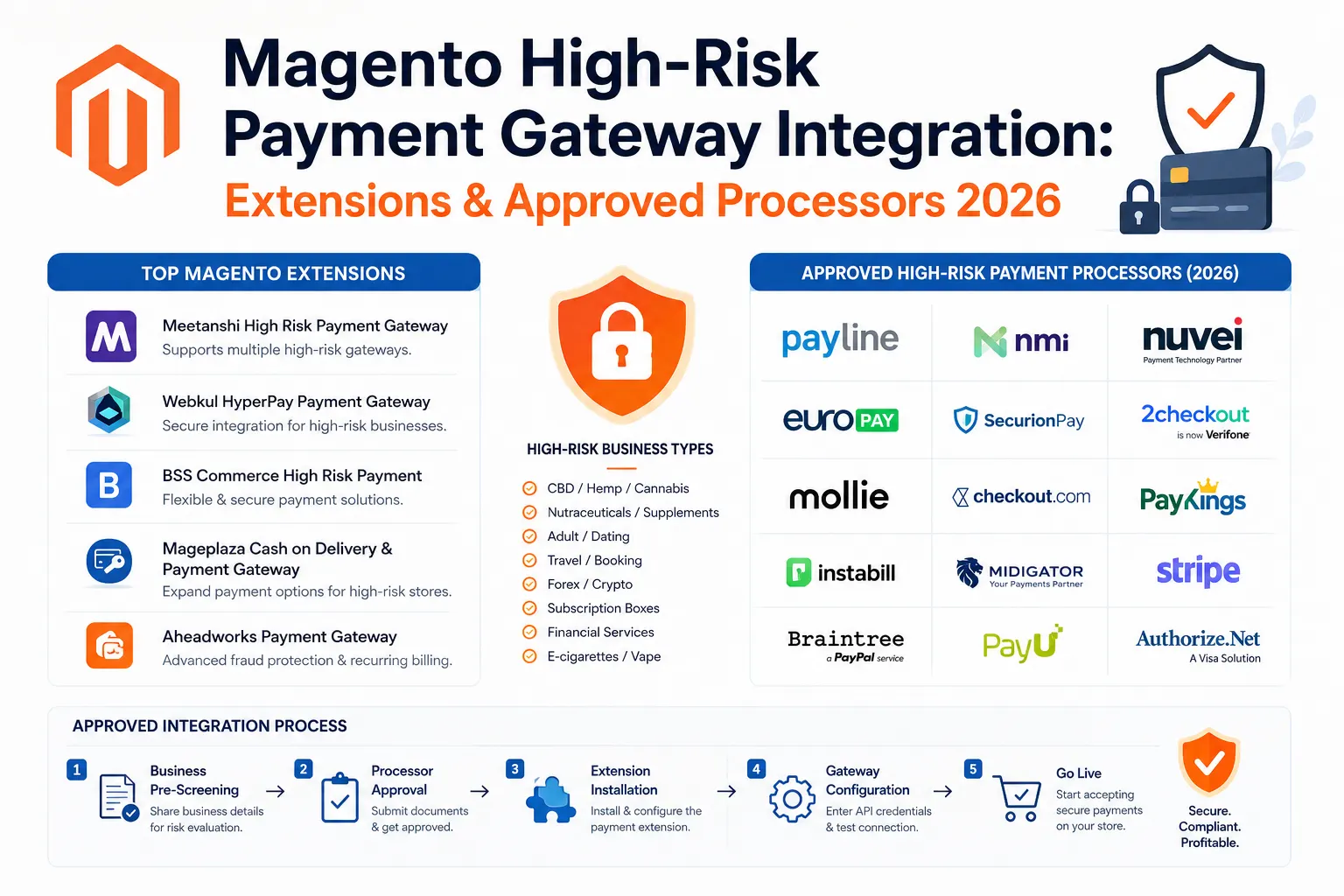
TL;DR: Magento (Adobe Commerce) is the most technically flexible eCommerce platform available, and for high-risk merchants, that flexibility is its defining advantage. With no platform-level payment restrictions, full open-source code access, and a mature extension ecosystem, Magento allows integration with virtually any payment gateway or high-risk payment processor. The trade-off is technical complexity, Magento rewards merchants with development resources and penalises those without them.
High-risk merchants running significant eCommerce operations need two things from their platform: technical flexibility and payment stack freedom. Magento delivers both more completely than any other major platform. There is no "Magento Payments" product pushing you toward a preferred processor. There are no transaction fees on third-party payment gateways. And the open-source architecture means any payment provider with a developer can build a working integration.
The cost of this freedom is complexity. Setting up high-risk payment processing on Magento requires more technical work than BigCommerce, more maintenance than Shopify, and more security overhead than hosted SaaS platforms. This guide covers exactly what that looks like, and which payment gateways, extensions, and processors actually work for high-risk verticals in 2026.
Magento in 2026: Platform Context
Magento, now branded Adobe Commerce in its enterprise edition and Magento Open Source in its community edition, remains the dominant self-hosted eCommerce platform for mid-market and enterprise merchants globally.
Key platform statistics:
- Magento powers approximately 260,000 active eCommerce sites globally (BuiltWith, 2025)
- Adobe Commerce (enterprise) accounts for approximately $50 billion in annual GMV processed through licensed installations
- Magento Open Source (free) is used by an estimated 180,000+ merchants, including a significant share of high-risk merchants and offshore merchants who value the self-hosted control it provides
- The Magento Marketplace lists over 3,800 extensions, including hundreds of payment gateway connectors
The distinction between Magento Open Source and Adobe Commerce matters for high-risk merchants:
Edition
Cost
Hosting
Support
Payment Flexibility
Magento Open Source
Free
Self-hosted
Community
Maximum - full code access
Adobe Commerce (cloud)
$22,000 –$125,000+/year
Adobe-managed cloud
Enterprise
High - but cloud restrictions apply
Adobe Commerce (on-prem)
Licence fee
Self-hosted
Enterprise
Maximum - full code access
High-risk merchants on tight budgets most commonly use Magento Open Source for its cost and control. Enterprise operators with compliance-heavy requirements often choose Adobe Commerce for the security patching and support infrastructure.
How Payment Gateway Integration Works on Magento
Unlike SaaS platforms that manage gateway integrations through an admin toggle, Magento payment gateway integration involves either:
- Installing a pre-built extension: from the Magento Marketplace or a third-party developer
- Developing a custom module: using Magento's Payment Gateway API framework
- Using a universal gateway adapter: (NMI, PaymentCloud) that reduces custom development to a single integration
Each approach has different cost, maintenance, and flexibility profiles, covered in the sections below.
Magento Payment Gateway API Framework
Magento's core payment framework provides a standardised structure for payment gateway integration. Any payment provider that builds to this framework can be integrated as a native Magento payment method, appearing in the checkout alongside other payment options, storing tokens in Magento's vault, and integrating with Magento's order management workflow.
Key framework capabilities relevant to high-risk merchants:
- Vault integration: Stored card tokens for repeat customers and subscription billing
- 3DS2 support: Native authentication framework for SCA-compliant EU processing
- Hosted fields: Embed payment fields directly in checkout without redirect (reduces PCI scope)
- Order status automation: Payment status automatically updates Magento order states
- Multi-store support: Single Magento instance can run multiple storefronts with different payment gateways per store
Approved Payment Gateway Extensions for High-Risk Merchants on Magento
Category 1 - Universal Gateway Adapters (Recommended Starting Point)
NMI (Network Merchants Inc.) - Magento Extension
NMI is the most versatile gateway option for high-risk merchants on Magento. As a gateway-of-gateways, NMI connects to 200+ underlying acquirers, including virtually every specialist high-risk payment processor in the market.
- Extension: Official NMI Magento extension (Magento Marketplace + GitHub)
- Integration type: Hosted fields + direct post
- Supported features: Vault tokenisation, subscription billing, 3DS2, Level 2/3 data
- Underlying acquirers: Durango Merchant Services, Payvision, Corepay, SMB Global, and 200+ others
- High-risk verticals: Adult, nutraceuticals, CBD (where legal), travel, offshore merchants
- Cost: NMI charges a monthly gateway fee ($10–$25) + per-transaction fee; extension itself is free/low-cost
Why NMI works: A high-risk merchant using Durango as their acquirer (which has no Magento extension) connects Durango → NMI → Magento. One extension, any acquirer.
PaymentCloud - Magento Integration
PaymentCloud is a US-based payment provider specialising in high-risk merchant accounts, nutraceuticals, adult, CBD, travel, and subscription businesses. They offer:
- Pre-built Magento integration via NMI gateway
- Bundled merchant account approval + gateway setup
- Dedicated high-risk onboarding team familiar with Magento implementation
- Merchant account approval rate significantly higher than standard acquirers for high-risk categories
Best for: High-risk merchants who need both merchant account approval and Magento gateway setup simultaneously.
Category 2 - Native High-Risk Processor Extensions
Nuvei - Magento Extension
Nuvei offers an official Magento extension on the Adobe Commerce Marketplace:
- Extension: Nuvei Payment Gateway for Magento 2
- Features: 3DS2, vault tokenisation, subscription support, 700+ payment methods, multi-currency
- Supported verticals: iGaming (via separate platform), nutraceuticals, forex, adult, crypto
- Smart routing: Transaction routing across Nuvei's acquiring relationships built into extension
- Compatibility: Magento 2.3+ and Adobe Commerce 2.4.x
For high-risk merchants already approved by Nuvei, the Magento extension delivers the full Nuvei feature set, including smart routing and cascade failover, directly in the Magento checkout.
Paysafe - Magento Integration
Paysafe provides Magento integration through its Paysafe Merchant Solutions payment gateway:
- Extension: Available via Paysafe developer portal and Magento Marketplace
- Features: Card processing, Skrill acceptance, Neteller acceptance, paysafecard, 3DS2
- Best for: iGaming-adjacent merchants; subscription merchants targeting European consumers
- Note: iGaming operators cannot use Magento as their primary gaming platform, Paysafe's Magento integration is for complementary eCommerce operations (merchandise, subscriptions) rather than core gambling platform processing
Credorax / Bluesnap - Magento Extension
- Extension: Bluesnap Payment Gateway for Magento 2 (Magento Marketplace)
- Features: Direct EU acquiring, multi-currency, 3DS2, subscription billing, 100+ payment methods
- Best for: EU-focused high-risk merchants in digital goods, SaaS, and nutraceuticals needing direct EU acquiring
- Compatibility: Magento 2.x and Adobe Commerce
Category 3 - Mid-Range Options with High-Risk Tolerance
Authorize.net - Magento Extension
- Official Adobe Commerce extension; well-maintained
- Accepts nutraceuticals and some continuity billing merchants
- Not suitable for adult, gambling, or forex
- Best for: Lower-risk high-risk categories where Authorize.net's risk appetite applies
Stripe - Magento Extension (with caveats)
- Official Stripe Payments extension for Magento
- Technically excellent - hosted fields, Apple Pay, Google Pay, 3DS2
- Not suitable for adult, gambling, CBD, nutraceuticals, or forex
- Only relevant for high-risk merchants in low-friction categories that Stripe accepts
Step-by-Step: Integrating a High-Risk Payment Gateway on Magento
Step 1 - Secure Your Merchant Account First
Before touching Magento, secure your merchant account approval from a specialist high-risk payment processor. Gateway setup without an underlying acquirer relationship is pointless. Required documents:
- Business incorporation and UBO documentation
- Processing history (3–6 months if available)
- Website with live ToS, refund policy, and privacy policy
- Applicable vertical licences (gambling, financial services)
- Projected monthly volume and average ticket size
Step 2 - Choose Your Integration Approach
Based on your approved processor and technical resources:
Situation
Recommended Approach
Processor has a Magento extension
Install native extension
Processor has no Magento extension
Connect via NMI gateway adapter
Need maximum customisation
Develop custom Magento module
Non-technical team
Use PaymentCloud (handles both merchant account + integration)
Step 3 - Install and Configure the Extension
Via Magento Marketplace or Composer:
composer require vendor/payment-gateway-extension
bin/magento module:enable Vendor_PaymentGateway
bin/magento setup:upgrade
bin/magento setup:di:compile
bin/magento cache:clean
Configure in Magento Admin → Stores → Configuration → Sales → Payment Methods.
Key configuration items for high-risk merchants:
- API credentials from your payment provider
- 3DS2 mode, enable and configure exemption handling
- Vault tokenisation, enable for returning customer card storage
- Currency configuration, ensure settlement currency matches your merchant account denomination
- Webhook endpoints, configure for payment status notifications
Step 4 - Configure Fraud and Risk Settings
High-risk merchants should layer additional fraud controls within Magento:
- IP blacklist rules: Block orders from high-risk geographies if not serving those markets
- Velocity rules: Maximum orders per IP/email per day
- Address validation: AVS matching rules for card orders
- 3rd-party fraud module: Magento extensions for Kount, Signifyd, or Magento's native fraud protection
Step 5 - Test in Staging Before Live
Never push a high-risk payment gateway live without thorough staging testing:
- Test successful transaction flow end-to-end
- Test 3DS2 authentication challenge and frictionless flows
- Test card decline handling, ensure soft decline retry logic works
- Test recurring billing, verify subscription setup and retry logic
- Test webhook handling, confirm order status updates correctly on payment events
- Test refund flow, verify refunds process correctly through the gateway back to the acquirer
Step 6 - Set Up a Backup Gateway
Configure a second payment gateway in Magento as a failover, displayed either as an alternate payment option at checkout or as an admin-only backup for manual order processing if the primary gateway goes down.
For high-risk merchants, a secondary merchant account and gateway should be active and tested before going live, not set up after the first gateway fails.
Magento vs BigCommerce vs Shopify for High-Risk Merchants
Factor
Magento Open Source
BigCommerce
Shopify
Platform cost
Free (hosting extra)
$299–$2,000+/month
$79–$399+/month
Transaction fees
None
None
0.5–2.0% on 3rd-party gateways
Payment gateway flexibility
✅ Maximum
✅ Excellent
⚠️ Moderate
High-risk gateway support
✅ Excellent
✅ Strong
⚠️ Limited
Technical complexity
❌ High
⚠️ Medium
✅ Low
Custom development needed
✅ Often required
⚠️ Sometimes
✅ Rarely
Extension ecosystem
✅ 3,800+ extensions
⚠️ Smaller
✅ 8,000+ apps
PCI compliance tools
✅ Full control
✅ Good
✅ Managed
Best for high-risk
✅ Technical merchants
✅ Non-technical merchants
⚠️ Low-risk preferred
Pros and Cons of Magento for High-Risk Merchants
Pros
- Zero platform-level payment restrictions: Magento itself imposes no product or payment constraints
- Full code control: Any payment provider can be integrated with sufficient development resource
- No transaction fees: 0% platform fee on all payment processing regardless of gateway
- Self-hosted data control: Customer and transaction data stays on your infrastructure; critical for offshore merchants with data sovereignty requirements
- Multi-store, multi-currency: Single Magento instance supports multiple storefronts with different gateways, currencies, and languages
- Vault tokenisation: Native PCI-scope-reducing card storage framework
Cons
- High technical complexity: Requires development expertise for installation, extension management, security patching, and gateway integration
- Maintenance overhead: Security patches, PHP version updates, and extension compatibility management are ongoing obligations
- Higher total cost: Free licence + hosting + developer costs frequently exceed managed platform costs at equivalent scale
- Slower extension updates: Third-party extensions sometimes lag behind Magento core updates; compatibility issues are common
- No managed payment solution: Unlike Shopify or BigCommerce, there is no integrated "just works" payment option; every setup requires configuration
Frequently Asked Questions
Q: Can Magento integrate with any high-risk payment gateway? A: Yes, through either a native extension, the NMI gateway adapter, or custom module development. Magento's open architecture means there is no payment provider it technically cannot integrate with, given sufficient development resource.
Q: Does Magento work for offshore merchants with international payment providers? A: Yes, and it is one of the strongest platforms for offshore merchants precisely because it imposes no payment restrictions and supports multi-currency, multi-store configurations. International payment providers without native Magento extensions can be connected via NMI.
Q: What is the best Magento extension for high-risk nutraceutical merchants? A: NMI connected to a specialist acquirer (PaymentCloud, Durango, or Nuvei) is the most reliable approach, it combines a well-maintained Magento extension with underlying acquirer flexibility for nutraceutical-specific underwriting.
Q: How does Magento handle PCI compliance for high-risk payment processing? A: Magento supports hosted fields and vault tokenisation that reduce PCI scope to SAQ A when implemented correctly. Self-hosted Magento installations carry more PCI responsibility than managed SaaS platforms, working with a QSA to validate your specific configuration is strongly recommended for high-risk merchants.
Q: Can I run subscription billing on Magento with a high-risk payment gateway? A: Yes, Magento's vault tokenisation framework supports stored card tokens for recurring billing. Combine with a payment gateway that supports subscription billing (Nuvei, NMI, Bluesnap) and a Magento subscription extension (Amasty Recurring Payments, ParadoxLabs Subscriptions) for a complete recurring billing setup.
Final Thoughts
Magento is the high-risk merchant's platform of choice when technical resources are available. No other major eCommerce platform offers the same combination of code-level control, zero payment restrictions, zero transaction fees, and multi-store flexibility. The NMI gateway adapter makes the question "does my processor have a Magento extension?" essentially irrelevant, any acquirer that works with NMI works with Magento.
The complexity is real and should not be understated. But for high-risk merchants who can manage it, or who invest in the development resources to manage it, Magento provides payment processing freedom that no SaaS platform can match.
→ Find Magento-compatible high-risk payment gateways and merchant account providers on TheFinRate's directory. https://thefinrate.com/magento-high-risk-payment-gateway-integration-extensions-approved-processors-2026/


Comments
Post a Comment