From High-Risk to Trusted: How Merchants Earn Lower Fees Over Time (2026 Guide)
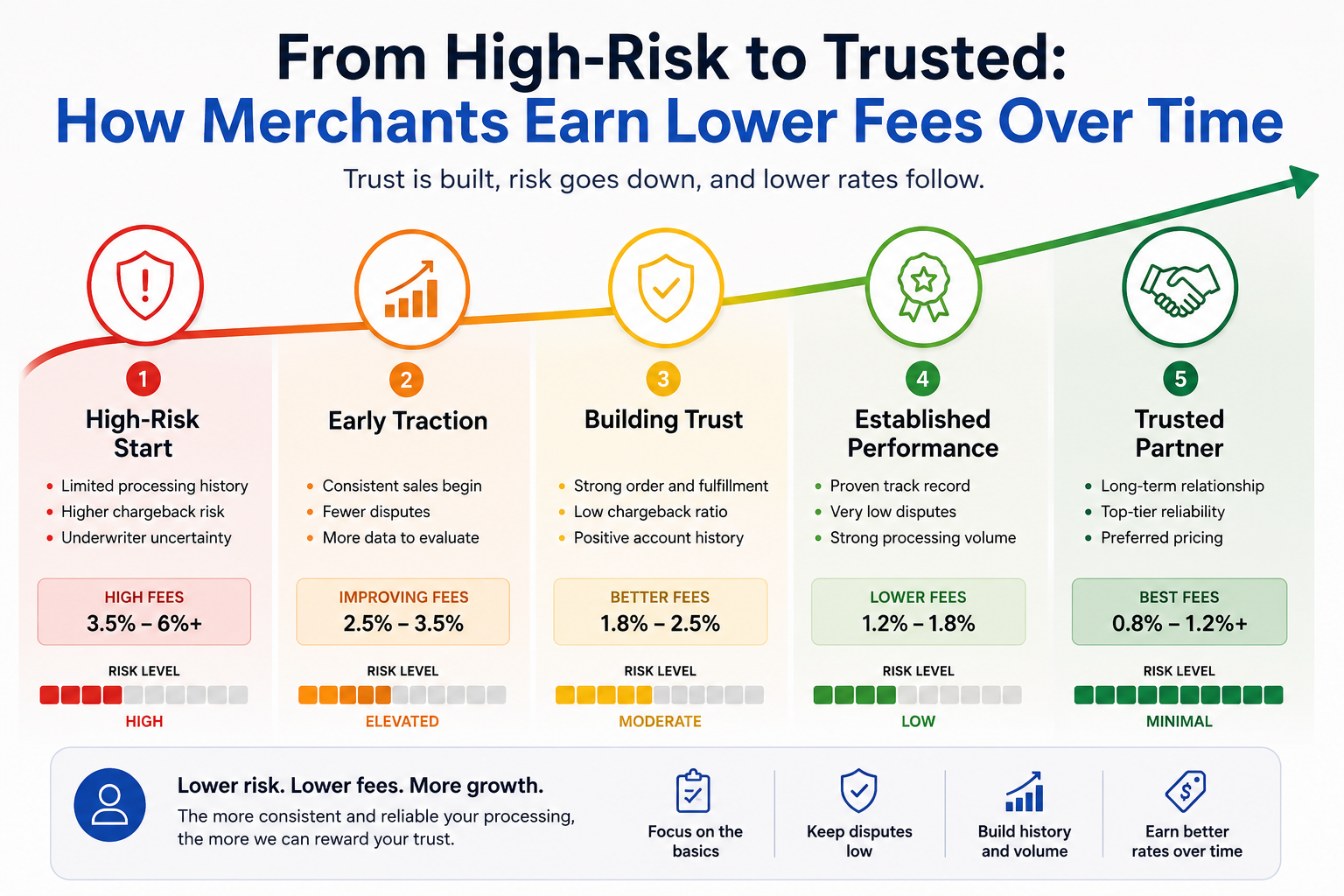
High-Risk Fees Are Not Permanent, They Are a Starting Point
Every high-risk merchant begins their processing relationship at maximum pricing. Transaction rates of 4%–8%, rolling reserves of 5%–15%, chargeback fees of $25–$100 per dispute, and monthly account fees that standard merchants never see, these are the terms an acquiring bank imposes when it knows almost nothing about how your business actually operates.
The critical thing most high-risk merchants do not realize is this: those initial terms are based on assumed risk, not demonstrated risk. Your processor does not yet know whether you will manage disputes proactively, maintain clean processing metrics, and operate a genuinely compliant business. They are pricing for the worst-case version of your industry, not the best-case version of you.
That gap between assumed risk and demonstrated risk is where the fee reduction opportunity lives.
You can lower your rates over time by reducing chargebacks, maintaining compliance, and renegotiating terms as your processing history improves. What most merchants miss is that this is not a passive process. Rates do not fall automatically. Reserves do not release themselves. The merchants who earn meaningfully lower fees over time are the ones who understand exactly what their processor is measuring, manage those metrics with intention, and request formal reviews at the right moments, with documented evidence in hand.
This guide gives you the exact framework to do that.
Understanding Why You're Paying High-Risk Rates in the First Place
Before you can lower your fees, you need to understand precisely what drives them. High-risk processing costs are not arbitrary. They reflect the specific financial exposure an acquiring bank accepts when it underwrites your account.
The Three Cost Drivers in Every High-Risk Rate
Chargeback exposure: When a customer files a dispute, the acquiring bank is liable for the disputed amount immediately, before recovering it from you. Your transaction rate includes a built-in risk premium that compensates the bank for this ongoing exposure. High-risk merchants typically pay more in transaction processing fees and chargeback fees to compensate for the danger they could potentially cause to the payment processor's bottom line.
Processing history vacuum: Poor or limited processing history means you're seen as a higher risk until you prove otherwise. This means higher fees initially, with a good chance to lower them if you keep chargeback rates low. A new merchant in any high-risk vertical starts with the highest rates because there is no data yet to justify anything lower. The data you generate in your first three to six months of processing is the single most powerful input into every subsequent rate review.
Industry classification: Your Merchant Category Code (MCC) is a baseline signal that precedes any review of your individual performance. Some MCCs carry structurally higher risk premiums that may never fully disappear, but even within the constraints of a high-risk MCC, the spread between the highest and lowest available rates for your category is wide enough to produce significant savings through demonstrated performance.
The Rate Reduction Ceiling
Not every high-risk merchant will achieve rates comparable to standard merchant accounts. An iGaming operator will never pay 1.8% effective rate, the structural risk of that MCC is real, and acquiring banks price it permanently into the relationship. But a SaaS business that started at 5.5% and now processes with clean metrics for 18 months can realistically work toward a 3.5%–4.0% effective rate. The ceiling varies by industry, but the floor is almost always lower than where you started. The journey from your opening rate to your optimized rate is the financial value of building a track record.
The Trust Timeline: What Processors Actually Watch
When an acquiring bank talks about "building trust," they are referring to a specific, measurable set of metrics that get reviewed at formal intervals. Understanding what is being measured, and when reviews typically occur, gives you a clear operational roadmap.
The Four Metrics That Drive Every Rate Review
1. Chargeback ratio: Your monthly dispute volume divided by your total transaction count. Visa's VAMP threshold in 2026 is 0.9%. Mastercard's is 1.0%. Staying consistently below 0.5% is the benchmark that most processors treat as the trigger for meaningful rate and reserve improvement conversations.
2. Fraud-to-sales ratio: Separate from chargebacks, this measures TC40 fraud reports as a percentage of your total card-not-present volume. Under Visa's VAMP framework, both fraud reports and disputes are combined in the VAMP ratio calculation, making fraud prevention as important as chargeback management for fee reduction purposes.
3. Volume consistency: Acquiring banks are most comfortable with merchants whose monthly volume is stable or grows predictably. Dramatic spikes in volume can trigger risk reviews. Sudden drops suggest business instability. Consistent, growing volume that stays within your approved processing limits is the strongest signal of a mature, well-managed operation.
4. Settlement and refund behavior: How quickly and cleanly you process refunds, how accurately your billing descriptors match your products, and how promptly you respond to pre-dispute alerts all factor into qualitative assessments that supplement the quantitative metrics above.
Phase 1 (Months 0–3): Survive and Stabilize
The primary objective of your first three months is not to negotiate, it is to generate a clean processing record that you can use as evidence in every conversation that follows.
What to Focus On in Phase 1
Keep chargeback ratio below 0.5% from day one: Do not wait for a chargeback problem to develop before implementing prevention tools. Deploy real-time chargeback alert services (Verifi, Ethoca) immediately, configure clear billing descriptors, and implement 3D Secure 2.0 authentication on all card-not-present transactions.
Stay within your approved volume limits: Exceeding your monthly processing cap triggers automatic risk review, can pause settlement, and damages the relationship with your acquiring bank at exactly the moment you need it to be building. Request a volume increase formally if your business grows faster than expected, do not simply process above your limit and hope it goes unnoticed.
Build clean transaction patterns: Consistent average ticket sizes, predictable card mixes, low refund rates, and accurate billing descriptors are all signals that contribute to the qualitative risk picture your processor builds about your account during these early months.
Respond to every alert within 24 hours: Pre-dispute alerts represent the best opportunity to resolve customer issues before they become formal chargebacks. A fast response rate to Verifi and Ethoca alerts, ideally above 90%, is one of the most visible positive signals in any account performance review.
Document everything: Keep monthly processing statements, chargeback reports, and alert response records organized and accessible. These become the evidence package for your Phase 2 and Phase 3 rate review requests.
Phase 2 (Months 3–6): Build the Track Record That Triggers Reviews
By month three, you have enough data to assess whether your metrics are trending in the right direction, and to begin planting the seeds for your first formal review conversation.
Key Actions in Phase 2
Request an informal performance check-in: Contact your dedicated account manager (if you have one) or your processor's merchant support team and ask for a review of your account metrics. Frame it as a business-building conversation, not a negotiation. Ask: "Are there specific benchmarks we should be targeting to position ourselves for a rate review at the six-month mark?"
Evaluate your rolling reserve position: With strong chargeback management, consistent volumes, and positive financial history, many providers will review and reduce reserves after three to six months. If your chargeback ratio has remained below 0.5% and your volume is consistent, you are likely eligible for a reserve percentage reduction or a shortening of the holding period, even if your provider does not proactively offer this.
Introduce supplemental compliance documentation: If your industry requires licenses, certifications, or lab results (nutraceuticals, CBD, telehealth), ensure these are current and proactively shared with your processor. Compliance documentation updates demonstrate operational maturity and reduce the qualitative risk perception that influences discretionary fee decisions.
Begin a competitive quote process quietly: Request indicative pricing from one or two alternative specialized processors. Do not submit formal applications, simply gather reference pricing for your industry vertical and processing profile. This competitive awareness strengthens your position in Phase 3 without triggering any disruption to your current account.
Phase 3 (Months 6–12): Request the Rate Review - With Evidence
The six-month mark is the first meaningful inflection point in the high-risk fee reduction journey. Processors negotiate pricing and reserve terms, then re-price once your metrics prove out. Month six is when you initiate that re-pricing conversation, and the quality of the evidence you bring determines the outcome.
Building Your Rate Review Package
Assemble the following before requesting any formal rate review:
- Six consecutive monthly processing statements: showing volume, transaction count, and chargeback ratio
- Chargeback ratio trend: specifically, consistent performance below 0.5% across all six months
- Alert response rate documentation: evidence of your pre-dispute alert response performance
- Refund rate summary: low refund rates signal strong customer satisfaction and low fraud exposure
- Compliance documentation: current PCI DSS compliance certificate, current industry licenses, current fraud tool configurations
- Competitive quote(s): reference pricing from alternative processors, framed as market context rather than a threat
What to Request - and How to Frame It
Request the review in writing via email to your account manager. Frame it as a partnership conversation: your business has demonstrated the risk profile of a mature, well-managed merchant, and you would like the terms to reflect that reality.
Specific items to negotiate at the six-month mark:
- Transaction rate reduction: target a 0.25%–0.75% reduction from your opening rate, depending on your chargeback performance and the margin your processor built into the original terms
- Rolling reserve reduction: target a 2%–5% reduction in the reserve percentage, or a reduction in the holding period from 180 days to 120 days
- Chargeback fee reduction: some processors will reduce per-dispute fees for merchants with demonstrably low chargeback rates
- Monthly fee elimination or reduction: if your account volume justifies it, monthly account maintenance fees are negotiable at this stage
7. Phase 4 (12+ Months): Negotiate From Strength
After twelve months of clean processing, you are in the strongest negotiating position available to a high-risk merchant. Merchants with a history of fewer chargebacks may negotiate for lower rates. If businesses can demonstrate low risk, they may secure more competitive terms and reduce overall transaction costs.
The 12-Month Negotiation Leverage Stack
By this point, you have built every element of a compelling rate reduction case:
- Twelve months of processing statements: demonstrating consistent volume and metric performance
- A documented chargeback ratio history: below card network thresholds
- A mature compliance posture: with current PCI DSS and industry certifications
- Market-rate competitive quotes: from alternative processors who have reviewed your actual track record
- A relationship with your account manager: built on demonstrated reliability
At twelve months, the rate discussion shifts from "give us a chance to prove ourselves" to "our track record demonstrates we are no longer the risk profile that justified these opening terms." That is a fundamentally different, and significantly more powerful, negotiating position.
Beyond Rate: What Else to Target at 12 Months
Full rolling reserve elimination: Many reserves are reviewable after 3–6 months of clean processing. Lower chargebacks, consistent volume, and good financials improve your chances of reducing the percentage, adding a cap, or removing the reserve entirely. At twelve months, request reserve elimination entirely rather than just reduction, and be prepared to provide updated bank statements, current processing history, and an updated business summary.
Volume cap increase: A larger approved monthly processing limit is not just an operational benefit, it is also a signal of the acquiring bank's confidence in your account. Request a volume increase concurrent with your rate review.
Transition to interchange-plus pricing: If your current account is on tiered or flat-rate pricing, request a migration to interchange-plus at this stage. The combination of improved rates and pricing model transparency compounds into significant long-term savings.
8. Rolling Reserve Reduction: The Fastest Cash Flow Win
For most high-risk merchants, the rolling reserve has a greater immediate cash flow impact than the transaction rate. For a merchant processing $50,000/month at a 5% reserve held 180 days, that's $25,000 tied up at steady state. Reducing the reserve percentage or the holding period frees capital that can be reinvested in the business immediately.
The Rolling Reserve Negotiation Framework
Understand what triggered your reserve: Reserves are imposed for specific reasons, new account without processing history, industry classification, prior chargeback issues, or limited financial history. Each reason has a different evidentiary solution. Sometimes reserves remain simply because the provider lacks updated data. If your original approval was based on conservative assumptions, new documentation can justify a lower reserve.
Request a review, not a removal: The most effective opening position is a request for a formal reserve review, not an immediate demand for elimination. Ask your processor to evaluate whether your current reserve percentage and holding period still reflect your demonstrated risk profile, and provide the documentation to support a reduction.
Target the holding period first: Even reducing the hold window from 180 days to 120 days can significantly improve cash flow. A 60-day reduction in the holding period on $50,000/month at 5% reserve frees approximately $10,000 in working capital, without changing the reserve percentage at all.
Use competitive alternatives as leverage: If your reserve was imposed due to limited history and you now have strong processing data, another high-risk provider may offer better terms. Processors who know you have evaluated alternatives and have a strong processing record to bring to a new relationship are more willing to compete on reserve terms.
9. Chargeback Management: The Single Biggest Lever on Your Rate
Everything in the rate reduction journey flows from chargeback management. Transaction rates, rolling reserves, chargeback fees, all three are directly influenced by your dispute metrics. The merchant who manages chargebacks proactively earns lower fees at every subsequent review point; the merchant who manages them reactively remains permanently anchored at opening rates.
The Chargeback Management Stack That Processors Reward
Pre-dispute alert services: Verifi and Ethoca alert you to customer disputes before they become formal chargebacks, giving you an opportunity to resolve them directly. An alert response rate above 90% is a visible metric that processors track and reward.
3D Secure 2.0 authentication: For card-not-present transactions, 3DS2 shifts fraud chargeback liability to the card issuer when authentication succeeds. This structurally removes a significant category of dispute risk from your chargeback ratio.
Clear billing descriptors: Unclear or generic billing descriptors are one of the most common triggers for friendly fraud. Your descriptor should clearly identify your business name and include a customer service phone number or URL. This single change alone typically reduces recognition disputes by 10–20%.
Proactive customer service at the point of dispute: A customer who cannot reach you easily will file a chargeback. A customer who can reach you and receives a rapid, professional response to their concern will not. Document your customer service response times and resolution rates, these are qualitative evidence in any rate review conversation.
Cancellation flow optimization: For subscription businesses, the single highest-leverage action for chargeback reduction is making cancellation easy. Counterintuitively, a frictionless cancellation flow reduces chargebacks by removing the dispute as a customer's only exit from an unwanted subscription.
10. VAMP Compliance in 2026: Why It Directly Affects Your Fees
Visa's Acquirer Monitoring Program (VAMP), which launched in April 2025 and tightened its thresholds in January 2026, directly connects your dispute metrics to your processing costs in a way that was not true under previous Visa monitoring frameworks.
VAMP enforcement is live, and thresholds tighten in January 2026. The VAMP Ratio measures the combined number of fraud reports and chargebacks against your total transaction volume. Through December 2025, merchants must stay below 1.5%. Starting January 2026, that threshold drops to 0.9%.
This threshold reduction changes the fee calculus for high-risk merchants in two important ways:
VAMP compliance is now a prerequisite for rate reduction, not just a penalty avoidance goal: Processors will not open rate review conversations with merchants who are operating near or above the 0.9% VAMP threshold, regardless of processing history length. Clean VAMP metrics are the price of admission to any fee reduction discussion.
VAMP-compliant merchants have genuine leverage: Proactive merchants who understand VAMP compliance for high-risk merchants protect their payment processing capabilities and demonstrate the risk management sophistication that acquirers reward with better rates and terms. An acquiring bank that sees a high-risk merchant operating with VAMP ratios well below threshold, consistent processing history, and documented chargeback management infrastructure is looking at a merchant they want to retain, and retention motivation translates directly into pricing flexibility.
Global Perspective: USA, UK, Canada & LATAM
🇺🇸 United States
U.S. high-risk merchants navigating rate reduction conversations must account for VAMP as the primary card network framework in 2026. The 0.9% VAMP ratio threshold applies across all Visa CNP volume, making chargeback and fraud management equally important as inputs to the same metric. Merchants with domestic U.S. https://thefinrate.com/from-high-risk-to-trusted-how-merchants-earn-lower-fees-over-time-2026-guide/


Comments
Post a Comment