Firearms & Ammunition Dealers: Payment Gateways That Say Yes (2026 Guide)
1. Why Firearms Businesses Face a Payment Processing Crisis
Over 42% of Americans own a firearm or live with someone who does. There are an estimated 393 million civilian-owned guns in the United States. The legal firearms and ammunition market generates billions of dollars in annual revenue, with 2020 recording the highest single-year sales volume in history, a record that has since driven sustained demand for online firearm purchasing infrastructure.
And yet, in 2026, a federally licensed gun dealer operating a fully legal, fully compliant business cannot open a merchant account with the majority of payment processors in the world.
This is not a fringe problem. It is the defining operational challenge of the modern firearms retail industry. Stripe, Square, PayPal, and virtually every major payment aggregator explicitly prohibit firearm and ammunition transactions in their terms of service. Most traditional acquiring banks avoid the category entirely. Many eCommerce platforms that technically allow firearm product listings still cannot pair those listings with functioning payment processing, because the processors they integrate with will not underwrite the transactions.
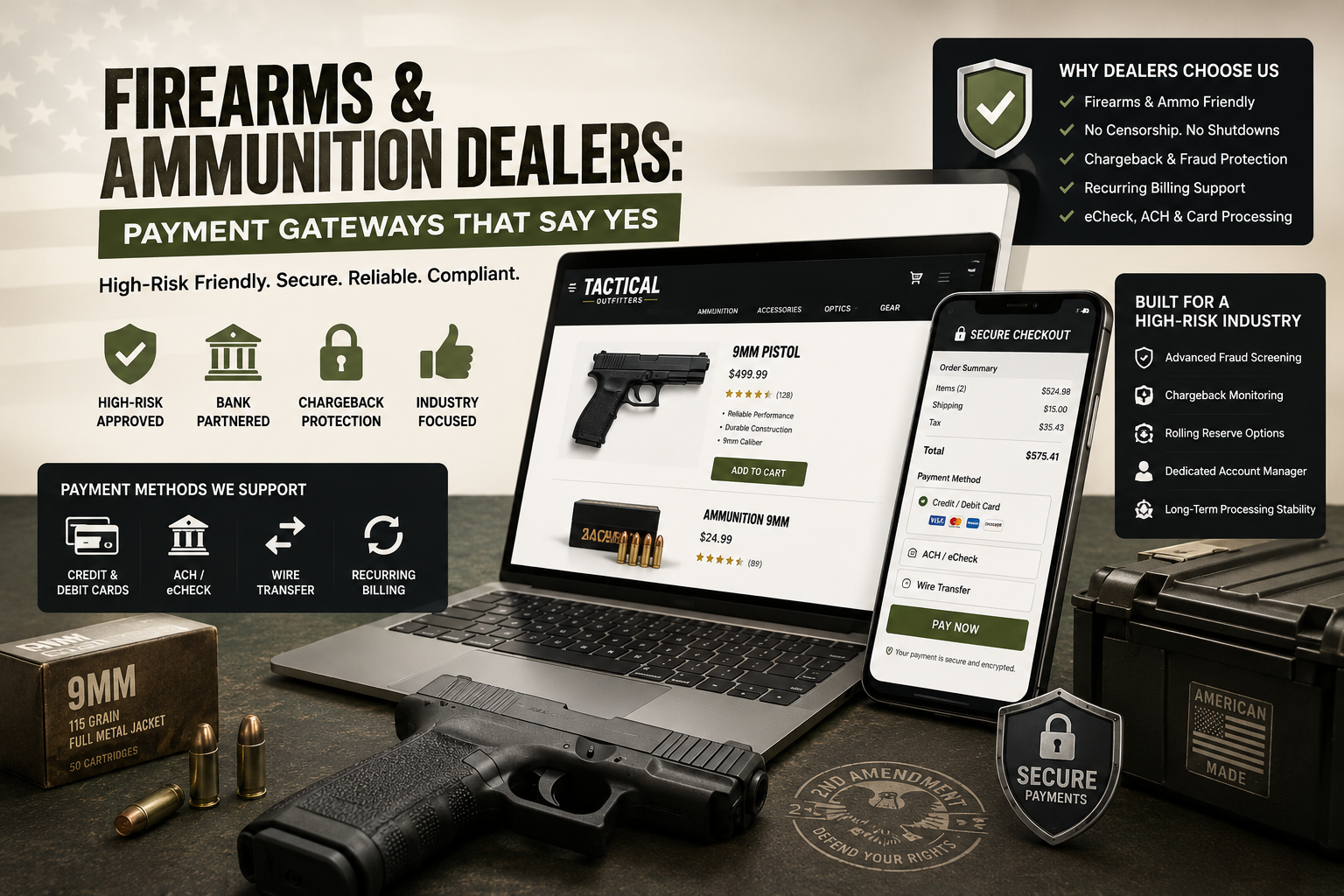
The result is a large, legal, growing market that is systematically denied access to the mainstream payment infrastructure that every other retail category takes for granted. For firearms and ammunition dealers, whether operating a physical gun shop, an online store, a gun show booth, or an FFL-to-FFL transfer service, the path to stable payment processing runs exclusively through high-risk payment gateway provider solutions designed specifically for Second Amendment businesses.
This guide maps that path precisely.
2. The Real Reasons Firearms Are Classified as High-Risk
The firearms industry's high-risk classification is driven by three converging forces: regulatory complexity, reputational sensitivity, and structural transaction risk. Understanding all three is essential for any firearms merchant building a compliant processing infrastructure.
Regulatory Complexity at Every Level
Gun and ammunition sales are subject to layered federal and state regulation that standard payment processors are neither equipped nor willing to navigate. At the federal level, the Gun Control Act of 1968 (GCA) establishes age restrictions, prohibited purchaser categories, and transfer requirements. State-level laws vary dramatically, California enforces strict controls on ammunition sales, semi-automatic weapon classifications, and high-capacity magazines, while states like Arizona maintain far more permissive frameworks. For payment processors, selling into multiple states increases risk, and many standard providers are unwilling to assess or monitor state-by-state compliance.
Reputational and Institutional Risk
Banks do not want to lose customers due to being tied to firearms companies. This reputational calculus, independent of any legal or financial risk, causes many acquiring banks to avoid the firearms category as a matter of institutional policy rather than a genuine underwriting assessment. The practical effect is that firearms merchants pay more, have access to fewer processors, and face higher termination risk than their actual financial performance would justify.
High Average Transaction Values and Fraud Exposure
Firearm sales often involve high-ticket transactions, with average gun prices ranging from $800 to $1,400. Many payment processors classify these sales as high-risk due to their value. High-ticket CNP transactions carry elevated fraud exposure, and firearms attract a specific fraud pattern (illegal purchases on stolen or third-party cards) that compounds the baseline risk for processors unwilling to invest in firearms-specific fraud controls.
3. MCC 5723: The Code That Changes Everything
In 2022, Visa and Mastercard, followed shortly by American Express and Discover, implemented Merchant Category Code 5723 specifically for firearms retailers. Previously, firearms retailers used more general codes, such as MCC 5941 for sporting goods stores. Creating a specific code for firearms retailers was intended to enable more granular data on where these transactions were occurring.
What MCC 5723 Means Operationally
Automatic high-risk classification: Any merchant assigned MCC 5723 is automatically flagged as high-risk at the card network level. Standard processors that do not serve high-risk categories will decline to underwrite any merchant with this code, regardless of the individual merchant's financial performance or compliance record.
Incorrect categorization carries penalties: Merchants must ensure their payment gateways are correctly categorized to avoid fines for incorrectly categorized business transactions. A firearms retailer who attempts to use a general sporting goods MCC (5941) to avoid the high-risk classification faces both card network penalties and legal exposure for misrepresenting the nature of their business.
State-level regulatory implications: Some states have enacted legislation regulating the use of MCC 5723, treating it as a data collection mechanism for firearms transaction monitoring. Firearms merchants operating in these states must work with processors who understand the regulatory implications of the code and can advise on compliant transaction structuring.
HSA/FSA limitations: Unlike healthcare or wellness MCCs, MCC 5723 does not support tax-advantaged payment card acceptance. This is a minor but occasionally relevant consideration for merchants selling legitimate safety accessories or defensive equipment.
The practical implication of MCC 5723 is clear: as the bridge between the firearm merchant's website and the payment processor, not all payment gateways are created equal and are firearm-friendly. Firearms merchants must use a payment gateway designed for high-risk industries to ensure compliance with regulations and facilitate firearm sales.
4. FFL Compliance & Why It's the Gateway to Processing Approval
For any firearms business seeking a high-risk merchant account, the Federal Firearms License (FFL) is the non-negotiable starting point. Individuals planning to sell firearms, ammunition, or gun accessories must initially secure a Federal Firearms License. This federally issued license authorizes the sale and trade of firearms and is a prerequisite for legal firearm sales. It is also a crucial step in establishing a high-risk payment processor for online or mobile sales.
What the FFL Covers - and What It Doesn't
The FFL establishes that the holder is authorized to engage in the business of dealing, manufacturing, or importing firearms at a specific licensed premises. For eCommerce firearms sales specifically, it is important to understand that FFL-licensed processors can only process online firearms transactions between FFL gun vendors, in other words, they cannot enable merchants to sell guns directly to consumers over the internet. Online firearm sales must be completed via FFL-to-FFL transfer, with the firearm shipped to a licensed FFL dealer near the purchaser who then completes the background check and legal transfer.
Ammunition sales do not require the same FFL as firearms sales, but payment processors still expect ammunition sellers to understand and comply with federal law, including prohibited purchaser rules and age restrictions.
FFL Documentation in the Underwriting Process
When applying for a high-risk merchant account as a firearms dealer, your FFL license is the primary compliance document that unlocks processor underwriting. Processors will verify the license validity, type, and expiration date. Key documents for the underwriting package:
- Federal Firearms License (current, unexpired)
- State-level dealer license (where required)
- Business registration and EIN documentation
- Three to six months of business bank statements
- Website with clearly published shipping policies, age verification statement, and FFL transfer requirement disclosures
- Prior processing statements (if available)
5. Why Stripe, Square & PayPal Will Always Say No
Companies like Stripe, Square, and PayPal will not be able to process payments for firearm-related businesses. These providers cannot service high-risk accounts. If you're using them and they find out, you will get your funds frozen due to firearm industry regulations.
This is not a temporary policy. It is a structural feature of how payment aggregators operate. Stripe, Square, and PayPal function as payment facilitators, they pool merchants under a single master merchant account, which means their own risk exposure includes every merchant on their platform. Maintaining firearms merchants on that master account creates card network compliance obligations, reputational exposure, and fraud management complexity that aggregators have consistently determined is not worth accepting.
The consequences for firearms merchants who attempt to use aggregators are severe and predictable:
- Immediate account termination: when automated risk systems identify firearms-related transaction patterns from product descriptions, customer statements, or website content
- Frozen funds: often held for 90–180 days during the termination review, with no guarantee of full release
- Potential MATCH listing: in cases where the processor determines the merchant misrepresented their business type during onboarding
- Loss of transaction history: the processing record built on an aggregator account cannot be transferred to a new processor
The only stable, long-term payment processing solution for any firearms or ammunition business is a dedicated high-risk merchant account with a processor that specifically underwrites and supports the firearms industry.
6. Payment Gateways That Say Yes: Top Options in 2026
The payment gateway is the technology layer that connects a firearms merchant's website or POS system to the payment processor. Not all gateways allow ammunition or firearm-related products, choosing a firearms-friendly gateway is as important as choosing a firearms-friendly processor. Several of the most popular payment gateway provider options have internal policies stating they will not facilitate the purchase or sale of firearms.
Firearms-Friendly Payment Gateways in 2026
Authorize.net (configured for FFL use): Authorize.net is widely compatible and, when set up correctly, allows nearly all FFL businesses to accept credit cards. It is important to note that Authorize.net's firearms-friendly status depends on correct configuration, the merchant account underlying the gateway must be specifically underwritten for firearms. An Authorize.net gateway connected to a standard merchant account will not work for firearms transactions. Authorize.net is compatible with FFL-compliant eCommerce platforms including GunBroker, WooCommerce, BigCommerce, and numerous FFL marketplace integrations.
Inovio Payment Gateway: Inovio's firearms-friendly payment gateway provides flexible, secure, and scalable processing with built-in fraud controls, 3D Secure authentication, certified Point-to-Point Encryption (P2PE), and Intelligent Transaction Routing. Inovio's platform supports full white-labeling through API and is built specifically for high-risk industries including firearms. Key feature: Transaction Recycling and Intelligent Transaction Routing significantly improve authorization rates for high-ticket firearms transactions that standard gateways decline.
NMI (Network Merchants Inc.): NMI is a gateway-agnostic platform widely used by high-risk payment gateway provider specialists in the firearms space. It integrates with firearms-specific eCommerce platforms and supports multi-processor routing, making it a strong foundation for multi-MID architecture, the recommended approach for any firearms merchant processing significant online volume.
GunBroker Checkout Integration: For firearms merchants selling on GunBroker, the largest online firearms marketplace in the U.S., GunBroker's Immediate Checkout system provides an integrated payment solution that is specifically designed for FFL-to-FFL firearm sales. Processors like EPIC Merchant Systems provide direct GunBroker Checkout gateway integration as part of their firearms merchant account packages.
7. Best High-Risk Merchant Account Providers for Firearms in 2026
The following high-risk merchant account provider options have demonstrated specific expertise, industry relationships, and firearms-friendly underwriting in 2026:
PaymentCloud: Best overall for firearms eCommerce. PaymentCloud specializes in serving high-risk business types, including point-of-sale solutions, mobile payment options, an online payment gateway and virtual terminal, EMV-compatible terminals, and merchant cash advances. PaymentCloud provides a dedicated account rep to all new merchants for the life of the account, with customized pricing based on business type and processing history.
Corepay: Best for FFL dealers and gun shops seeking fast approval. Corepay specializes in high-risk merchant accounts for FFL dealers, gun shops, and online firearms retailers, with approvals often within 24–72 hours. No application fees, setup fees, or annual fees. Deep industry knowledge of both retail and eCommerce firearms processing, with chargeback management tools built into the account.
High Risk Pay: Best for full-spectrum firearms and ammunition coverage. High Risk Pay supports a wide range of firearm-related businesses including FFL dealers, gun shops, online firearm retailers, ammunition sellers, firearm training courses, concealed carry permit classes, tactical supply stores, military surplus businesses, and ammunition subscription services. Integrates with FFL-compliant eCommerce platforms including GunBroker, WooCommerce, and Shopify.
Inovio: Best for technology-forward firearms merchants. Inovio has been offering affordable high-risk merchant accounts to firearms-related businesses for years, with PCI-compliant processing solutions, the latest POS systems, and white-glove customer care and technical support. Military-grade tokenization, certified P2PE, and intelligent transaction routing make Inovio the strongest technological option for high-volume online firearms retailers.
EPIC Merchant Systems: Best for FFL-focused retail and GunBroker sellers. Veteran-owned and specifically built for FFL dealers, EPIC offers seamless payment solutions for home-based, retail, and online firearm businesses with direct GunBroker Checkout integration. EPIC ZERO surcharge model eliminates processing fees entirely for merchants, customers who pay by card cover the processing cost at checkout.
Structure Payments: Best for merchants seeking NRA-endorsed processing infrastructure. Structure Payments boasts almost 50 NRA-endorsed credit card processing solutions with robust risk management strategies including advanced fraud detection tools, real-time transaction monitoring, and chargeback prevention measures.
Host Merchant Services: Best for transparent, interchange-plus pricing with no early termination fees. Host offers interchange-plus pricing to all firearms merchants and provides free website and email address setup, a strong option for brick-and-mortar gun shops moving into online sales for the first time.
8. Chargeback Risks Unique to Firearms & Ammunition Sales
While many high-risk industries face similar reasons for chargebacks including fraud and buyer's remorse, firearms come with an additional important factor. Chargebacks can occur in the firearms industry if the person purchasing the gun is a felon. It is illegal to sell to a felon, what typically happens is the customer will obtain someone else's credit card and place the order. The charge will go through, and then it will get investigated, ultimately leading to a chargeback in which the processor and the bank lose money.
The Five Chargeback Patterns Firearms Merchants Must Manage
1. Prohibited purchaser fraud: A felon or other prohibited person uses a stolen or third-party card to purchase a firearm. The NICS background check at the FFL dealer's location will prevent the transfer, but the chargeback on the original transaction still hits the selling merchant's account.
2. High-ticket buyer's remorse: At average transaction values of $800–$1,400, buyer's remorse chargebacks on firearms purchases represent significant per-dispute losses. Clear, documented sales agreements and evidence of customer intent are essential for dispute defense.
3. Card testing on high-value items: Fraudsters target firearms purchases for card testing due to the high transaction values and the fact that firearms are desirable targets for resale. A BIN checker that verifies the state from which customers are ordering, combined with velocity controls, is essential for detecting card testing patterns.
4. State compliance disputes: A customer in California orders a product that is legal federally but restricted in their state. When the merchant cannot fulfill the order due to compliance requirements, the customer disputes the charge rather than accepting a refund. Clear state-level compliance disclosures on your website and checkout flow are the primary defense.
5. FFL transfer failures: A customer orders a firearm online, and the designated receiving FFL dealer refuses the transfer (due to store policy, state law, or other reasons). The customer disputes the transaction even though the selling merchant completed their obligations. Document all FFL transfer communications and maintain a clear FFL transfer policy on your website.
Chargeback Prevention Framework for Firearms Merchants
- Deploy fraud-scoring software that leverages hardware IDs, IP addresses, and other data to assess the risk of fraudulent transactions before they occur
- Implement a BIN checker that verifies customer location against state-level compliance requirements
- Maintain documentation of every transaction including FFL confirmation, background check initiation, and customer communication records
- Employ a customer service protocol that resolves customer disputes before they are charged to the merchant's account
- Use real-time chargeback alert services (Verifi, Ethoca) to intercept disputes before they become formal chargebacks


Comments
Post a Comment