EMI Accounts for High-Risk Merchants: Top Electronic Money Institutions in the EU
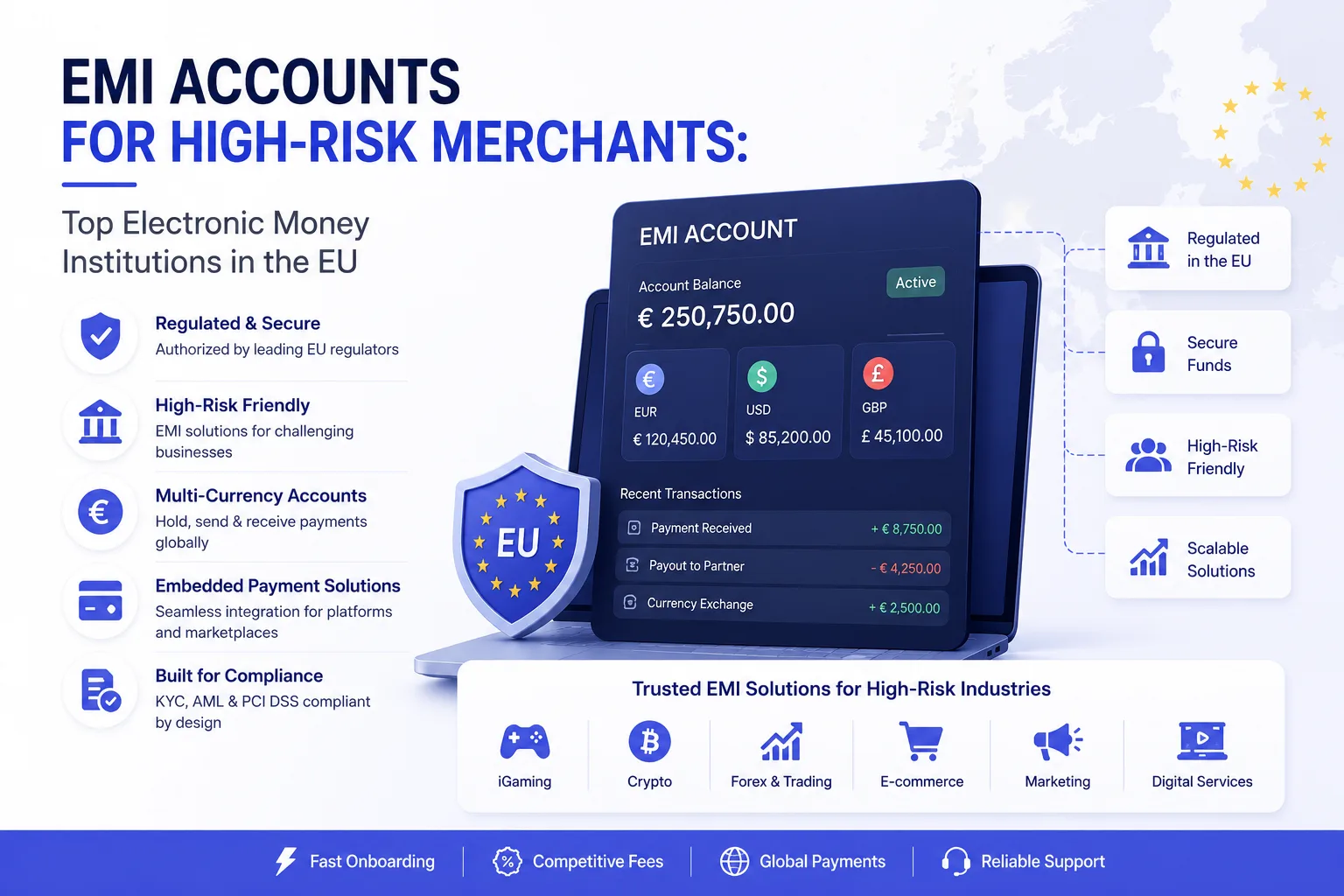
Traditional banks will not open accounts for most high-risk businesses. That is not speculation, it is a documented operational reality for merchants in iGaming, crypto, forex, adult content, nutraceuticals, and dozens of other sectors. The application gets declined, funds get frozen, or the relationship gets terminated without warning.
Electronic Money Institutions fill that gap. EMIs are regulated, licensed entities that can hold merchant funds, provide IBAN accounts, process payments, and issue cards, without the restrictions that traditional banks impose on high-risk verticals.
But not all EMIs accept high-risk merchants. And in 2026, with PSD3 on the horizon and compliance requirements tightening, choosing the wrong EMI creates operational risk, not just inconvenience.
TL;DR EMI accounts give high-risk merchants access to regulated EU banking infrastructure, IBANs, SEPA payments, card issuing, and multi-currency accounts, without needing a traditional bank. Lithuania and Cyprus are the dominant EU jurisdictions for high-risk EMI access. This blog covers how EMI accounts work, which providers accept high-risk merchants, what fees look like in 2026, and how to evaluate your options before applying.
What Is an EMI Account and How Is It Different From a Bank Account?
An Electronic Money Institution is a regulated non-bank authorised to issue electronic money, hold customer funds in safeguarded accounts, and provide the full set of payment services under PSD2. The EMI license is the backbone of most neobanks, crypto on/off ramps, remittance apps, corporate expense platforms, and embedded finance products shipped in Europe over the past decade.
In practical terms, an EMI account works like a business bank account for most day-to-day purposes, you get an IBAN, can send and receive SEPA transfers, hold balances in multiple currencies, and issue cards linked to the account. The key difference is structural: what an EMI cannot do is equally important, no fractional reserve lending from its own balance sheet, no interest on client balances out of the safeguarded pool, no issuance of credit products funded by customer deposits.
For high-risk merchants, that distinction matters less than the primary advantage: EMIs are significantly more willing to onboard high-risk business categories than traditional banks.
Why High-Risk Merchants Need EMI Accounts in 2026
The approval rate problem is real and quantified. Approval rates across the wider EU market sit at just 35 to 40% for sectors like crypto, iGaming, and Forex, meaning the majority of applications fail before trading even begins.
Traditional banks use reputation risk frameworks to decline entire verticals. EMIs, particularly those licensed in Lithuania and Cyprus, operate with a more pragmatic underwriting approach, evaluating merchants on compliance documentation, AML procedures, and business model clarity rather than blanket category exclusions.
The other driver is operational resilience. The 2026 market has made clear that single-provider banking is a liability. Operators who rely on one EMI, one processor, or one acquiring bank are one policy update away from a frozen account. EMI accounts give high-risk merchants a regulated, passportable alternative to traditional banking that does not depend on the goodwill of a risk-averse commercial bank.
How EMI Accounts Work for High-Risk Merchants
Understanding what an EMI account actually provides helps you match the right provider to your specific payment processing needs.
What You Get With an EU EMI Account
Dedicated IBAN: multi-currency IBANs in EUR, GBP, USD, and additional currencies depending on provider
SEPA access: Credit Transfers, Instant Payments, and Direct Debits across 36 SEPA countries
SWIFT for international transfers: cross-border payment processing outside the SEPA zone
Card issuing: Visa and Mastercard debit or prepaid cards linked to the account
Merchant services integration: connect your EMI account to payment gateways and merchant accounts
Safeguarded funds: client money held in segregated accounts at approved EU credit institutions, separate from the EMI's own funds
EU passporting: an EU EMI license includes passporting rights across all 30 EEA member states under freedom of services or freedom of establishment, one authorization covers the entire EU single market.
What EMI Accounts Do Not Replace
An EMI account handles banking infrastructure, it does not replace a dedicated high-risk merchant account for card payment acquiring. You still need a separate payment gateway and merchant account for processing customer card transactions. The EMI handles the settlement and banking layer; card acquiring is separate.
Top EU Jurisdictions for High-Risk EMI Access
Not every EU jurisdiction is equally accessible for high-risk merchants seeking EMI accounts. Regulatory attitude toward high-risk sectors varies significantly by country.
Jurisdiction
Regulator
High-Risk Acceptance
Passporting
Notable Advantage
Lithuania
Bank of Lithuania
Strong - iGaming, crypto, forex
Full EU/EEA
Direct SEPA via CENTROlink; 80+ EMIs licensed
Cyprus
CySEC
Strong - iGaming, crypto, VASPs
Full EU/EEA
Lower setup costs; strong iGaming track record
Malta
MFSA
Moderate - iGaming specialist
Full EU/EEA
MGA gambling license synergy
Ireland
Central Bank of Ireland
Selective - lower high-risk appetite
Full EU/EEA
Global platform preference (Stripe, Coinbase)
France
ACPR
Domestic-first; selective
Full EU/EEA
Strong for EU-HQ fintech
In Lithuania and Cyprus, EMI licenses are routinely used by fintech companies serving crypto exchanges, VASPs, and iGaming operators. The regulator's attitude toward high-risk sectors varies by jurisdiction, Lithuania and Cyprus are generally more accommodating than Ireland for these client types.
Lithuania has become the dominant EU EMI hub for high-risk operators. Lithuania has authorized more than 80 electronic money institutions, making it one of the largest EMI hubs in the EU by number of authorized institutions.
Top EMI Providers Accepting High-Risk Merchants in 2026
1. Genome (Lithuania-regulated EMI)
Genome is a Lithuanian-regulated EMI offering high-risk merchant account pricing with transparent fee structures and multi-currency IBANs. It explicitly lists betting and gambling (licensed and regulated), skill games, lotteries, affiliate marketing, and subscription services as accepted high-risk categories. One of the few EMIs with publicly documented high-risk pricing, useful for budget planning before application.
Best for: iGaming operators, affiliate networks, subscription businesses, EU-licensed gambling operators.
2. Intergiro (Swedish EMI)
Intergiro holds a Swedish EMI license with strong coverage for offshore and EU merchant accounts. Known for broader high-risk category acceptance than most mainstream EMIs, with multi-currency account infrastructure suited to cross-border payment processing. Particularly relevant for merchants that need offshore-friendly banking alongside EU regulatory standing.
Best for: Offshore merchants needing EU credibility, cross-border high-risk operations.
3. Treezor (French EMI - Société Générale subsidiary)
Treezor holds its own French EMI license and operates as a BaaS provider with embedded compliance infrastructure. Accepts iGaming-adjacent categories and crypto-related businesses, with full EU passporting. The Société Générale backing provides banking-grade stability that smaller EMIs cannot match.
Best for: High-risk platforms needing embedded finance capabilities alongside merchant banking.
4. Xpaid (Crypto IBAN specialist)
Xpaid specialises in bridging crypto IBANs with high-risk business banking, making it particularly valuable for crypto exchanges and Web3 operators. For businesses operating at the intersection of crypto and traditional payment processing, Xpaid addresses the specific problem of moving between fiat and crypto rails within a regulated EU framework.
Best for: Crypto exchanges, Web3 operators, businesses needing crypto-to-fiat settlement infrastructure.
5. Finera (Cyprus-based)
Finera is a payment orchestration platform built for iGaming and high-risk merchants, Cyprus-based with 100+ employees. Combines EMI account services with payment orchestration, meaning merchants can access both banking infrastructure and payment routing from a single provider, reducing integration complexity for iGaming operators specifically.
Best for: iGaming operators that need combined EMI banking and payment orchestration.
6. AstroPay (FCA EMI + multiple licenses)
AstroPay is an FCA-authorized EMI with additional Isle of Man and Brazil Central Bank licenses, and a 4.3/5 Trustpilot score from over 9,500 reviews. Particularly strong for operators with significant LATAM traffic where standard card payment processing faces structural decline rates.
Best for: iGaming and high-risk operators with LATAM exposure needing e-wallet infrastructure.
EMI Account Fees for High-Risk Merchants in 2026
EMI account pricing for high-risk merchants is higher than standard business accounts, reflecting the additional compliance work required for onboarding and ongoing monitoring. Here is what the market looks like in 2026.
Fee Component
Standard Business
High-Risk Category
Monthly Administration Fee
€50–€150
€150–€500+
SEPA Transfer (outgoing)
€0.20–€1.00
€0.50–€2.00
SWIFT Transfer (international)
€15–€30
€25–€50
Card Issuance (virtual)
€0–€5
€5–€20
FX Conversion Fee
0.5%–1.5%
1%–2.5%
Onboarding / Due Diligence
€500–€2,000
€1,000–€5,000
Rolling Reserve (where applicable)
None
5–10% for 3–6 months
The most significant cost variable for high-risk merchants is the rolling reserve. Rolling reserves, typically 5–10% of monthly volume held for 6 months, add a liquidity burden most operators do not budget for until they hit their first payout cycle. Factor this into cash flow planning from day one.
Transaction Fee Benchmarks by License and EMI Combination
Average transaction fee ranges in 2026 vary significantly by license and banking combination: MGA plus Lithuanian EMI runs 1.5–3.5%, MGA plus Bank of Valletta runs 2–4%, Isle of Man or Gibraltar plus EMI runs 2.5–5%, and Curacao plus a Caribbean offshore account runs 8–12%. Azify
The data is clear: EU-licensed operators using Lithuanian or Maltese EMIs access materially lower effective transaction costs than offshore-only arrangements. The compliance investment in an EU-jurisdictioned structure pays back in processing economics.
EMI Account Requirements: What High-Risk Merchants Need to Prepare
EMI onboarding for high-risk merchants is more demanding than standard business account applications. Preparation quality directly affects approval speed and outcome.
Standard Documentation Requirements
Business registration documents: certificate of incorporation, memorandum and articles of association
Beneficial ownership disclosure: UBO register extract or equivalent for all owners holding 25%+ interest
AML/KYC policy documentation: written AML procedures and appointed MLRO details
Gambling or sector license: for iGaming operators, active license documentation is typically required
Business model description: clear explanation of revenue model, customer types, and geographic markets
Processing history: 3–6 months of bank statements or payment processing statements
Chargeback rate history: for merchants with processing history; rates above 1% significantly reduce approval probability
Website compliance: terms of service, privacy policy, responsible gambling tools (for iGaming)
Pros and Cons of EMI Accounts for High-Risk Merchants
Pros
Regulated EU infrastructure accessible to high-risk verticals that traditional banks decline
Full EU passporting, one account covers all 30 EEA member states
Safeguarded funds in segregated accounts, protection in the event of EMI failure
Multi-currency IBANs for cross-border payment processing and offshore merchant operations
Card issuing capabilities for merchant payouts and business spending
Lower effective transaction costs than offshore-only banking arrangements
PSD3 grandfathering, EMI licenses obtained in 2026 remain valid through 2028+ without re-authorization
Cons
Higher fees than standard business accounts: rolling reserves add significant liquidity requirements
Onboarding is rigorous: documentation requirements are substantial for high-risk categories
EMIs cannot lend: no credit facilities, overdrafts, or business financing
Not a replacement: for a dedicated high-risk merchant account and payment gateway for card acquiring
Provider quality varies: some EMIs have thin compliance infrastructure that creates operational risk
Safeguarding account access is increasingly difficult: securing a safeguarding account with a willing banking partner has become one of the most significant practical challenges for new Lithuanian EMI applicants in 2026.
EMI vs. Traditional Bank vs. Offshore Account: Which Does a High-Risk Merchant Need?
Factor
Traditional Bank
EU EMI Account
Offshore Bank Account
High-Risk Acceptance
Very Low
Moderate–High
High
EU Passporting
N/A
Full EEA
No
SEPA Access
Yes
Yes
Limited
Regulatory Protection
Strong
Strong
Weak–Moderate
Transaction Costs
Low
Medium
High (8–15%)
Onboarding Speed
Slow (months)
Medium (weeks)
Fast (days)
Lending / Credit
Yes
No
Limited
Fund Safeguarding
Deposit insurance
Segregated accounts
Varies
Stability Risk
Low
Medium
Higher
For most EU-operating high-risk merchants, the answer is an EMI account as the primary banking layer, combined with a specialist high-risk merchant account for card payment acquiring. Offshore accounts can supplement for specific jurisdictional needs, but as a primary banking solution in 2026, the cost and risk profile makes them a last resort rather than a first choice.
PSD3: What It Means for EMI Accounts in 2026
The regulatory environment for EMI accounts is changing. PSD3 merges EMI and PI licensing into a unified Payment Institution framework, with EMD2 repealed. Entry into force is expected late 2027 with 24-month grandfathering for existing licenses.
For high-risk merchants evaluating EMI accounts in 2026, the practical implication is positive: applying now under the current PSD2/EMD2 framework secures an EMI license that will grandfather automatically when PSD3 enters into force. Applying in 2026 under the current framework is correct, the license will grandfather automatically. No immediate re-application is required for existing licensees.
This makes 2026 a strategically advantageous window for high-risk businesses to establish EU EMI relationships before the regulatory transition creates uncertainty.
Final Verdict
EMI accounts are the most practical regulated banking solution for high-risk merchants operating in or targeting the EU market in 2026. The combination of EU passporting, safeguarded funds, SEPA access, and multi-currency infrastructure, from providers willing to onboard high-risk categories, fills a gap that traditional banks have deliberately left open.
Lithuania and Cyprus remain the dominant jurisdictions for high-risk EMI access. Providers like Genome, Intergiro, Treezor, and Finera have built product infrastructure around the specific compliance and operational needs of iGaming, crypto, forex, and other elevated-risk categories.
The caveats are real: rolling reserves require cash flow planning, onboarding documentation is demanding, and an EMI account does not replace a dedicated high-risk payment gateway for card acquiring. Build both, the EMI for your banking layer and a specialist merchant account for card processing, and you have payment infrastructure that does not depend on the willingness of a traditional bank to maintain the relationship.
Frequently Asked Questions
Can high-risk merchants get EMI accounts in the EU? Yes. EMIs in Lithuania, Cyprus, and Malta are significantly more willing to onboard high-risk verticals, including iGaming, crypto, forex, and adult content, than traditional banks. Approval depends on compliance documentation quality, AML procedures, and chargeback history. The overall EU approval rate for high-risk sectors sits at 35–40%, so preparation quality matters.
What is the difference between an EMI account and a high-risk merchant account? An EMI account provides banking infrastructure, IBANs, SEPA transfers, fund holding, and card issuing. A high-risk merchant account provides card payment acquiring, the ability to accept customer card payments. Most high-risk businesses need both, operating together. They serve different functions in the payment processing stack.
Which EU jurisdiction is best for high-risk EMI accounts? Lithuania is the most accessible for international high-risk operators, it has the most licensed EMIs in the EU, offers direct SEPA access via CENTROlink, does not require director residency, and the Bank of Lithuania has a pragmatic approach to high-risk fintech categories. Cyprus is a strong alternative, particularly for iGaming operators.
How much do EMI accounts cost for high-risk merchants? Monthly administration fees for high-risk categories typically run €150–€500+, with onboarding due diligence fees of €1,000–€5,000. The most significant cost is rolling reserves of 5–10% of monthly volume held for 3–6 months. Effective transaction costs using an EU EMI alongside an MGA license run 1.5–3.5%, significantly lower than offshore-only arrangements at 8–15%.
Will PSD3 affect existing EMI accounts? Existing EMI licenses obtained before PSD3 enters into force will be grandfathered for 24 months. PSD3 is expected to enter into force in late 2027, meaning licenses obtained in 2026 remain valid without re-authorization through 2028 or beyond. Applying now under the current framework is strategically advantageous.
https://thefinrate.com/82833-2/

Comments
Post a Comment