Correspondent Banking Risks for High-Risk Businesses: How to Avoid Being Debanked (2026)
TL;DR: Correspondent banking, the system where your bank routes payments through a larger upstream institution, is the hidden cause of most unexpected debanking events for high-risk merchants. When a tier-1 correspondent bank decides your bank carries too much risk, it can sever the relationship instantly, taking down your merchant account with it, even if you've done nothing wrong. Protection comes down to infrastructure resilience: multiple merchant accounts, multiple payment gateways, banking across two or more jurisdictions, proactive chargeback management, and working with specialist high-risk acquirers who have built their correspondent relationships specifically for your vertical.
One day your merchant account is processing normally. The next, you receive a terse letter informing you that your account has been closed, effective immediately, sometimes with funds held for 90 to 180 days. No warning. No appeals process. No explanation beyond a vague reference to "risk appetite."
This is debanking, and for high-risk merchants, it's one of the most operationally destructive events a business can face. In many cases, the cause isn't your own bank at all, it's a correspondent banking relationship your bank holds with a larger financial institution, one you've never interacted with and often don't even know exists.
Understanding how correspondent banking works, why it triggers debanking, and how to build resilient payment processing infrastructure around it is essential knowledge for any merchant operating in a high-risk vertical in 2026.
What Is Correspondent Banking?
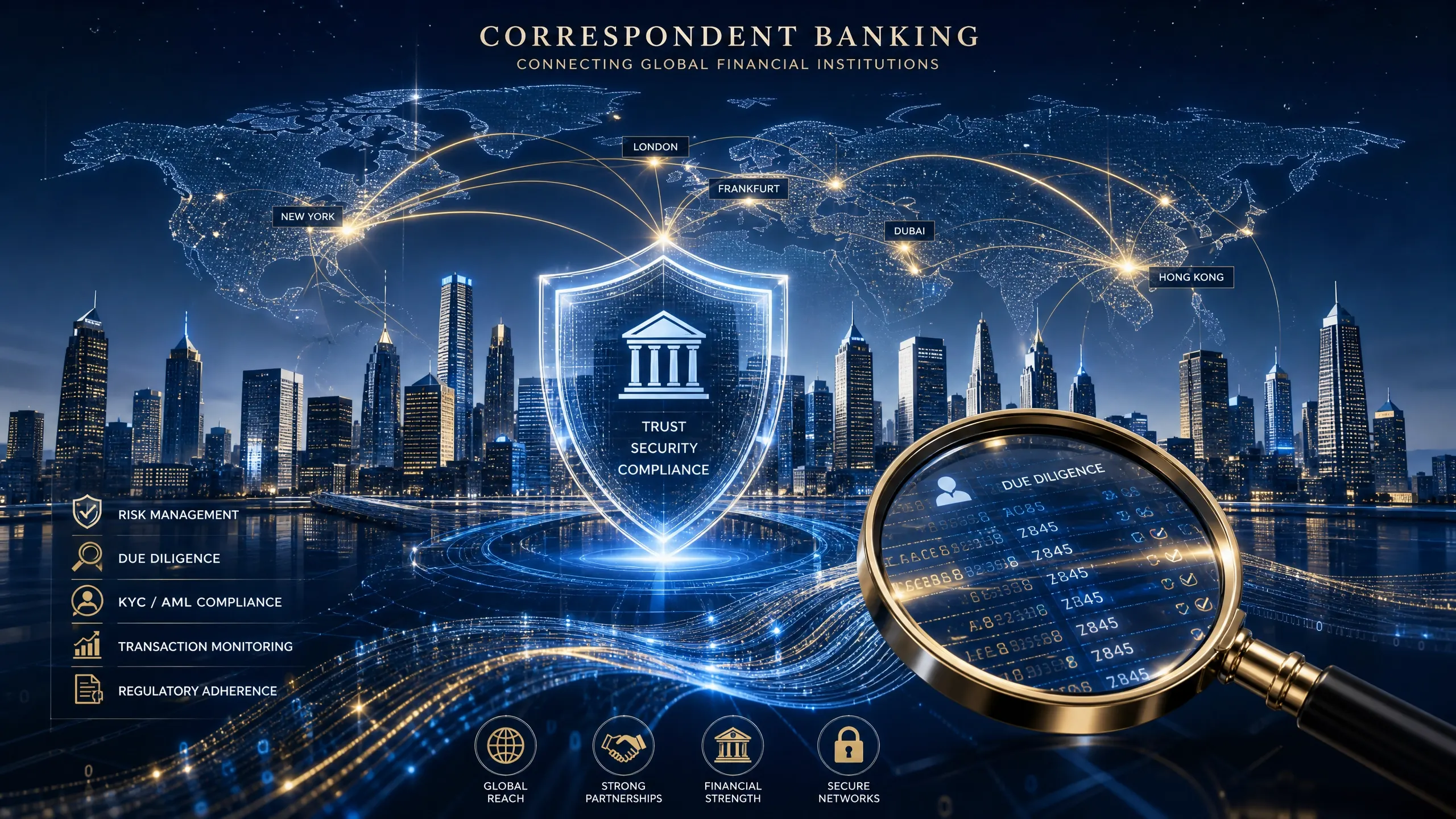
Correspondent banking is the mechanism by which banks in different countries settle transactions for one another. When your business's bank, perhaps a smaller regional institution or an offshore bank, processes an international wire or card transaction, it typically does so through a correspondent bank: a larger, globally connected financial institution (often a US, UK, or European tier-1 bank) that maintains accounts and settles on behalf of the smaller bank.
This system underpins the vast majority of global payment processing. According to the Bank for International Settlements (BIS), over 75% of global cross-border payments still flow through correspondent banking networks, representing trillions of dollars in annual settlements.
The problem for high-risk merchants is structural: the correspondent bank sits above your bank and your merchant account, and it applies its own compliance filters, filters that are often far stricter than your direct banking partner's.
How the Chain Works
Your Business
↓
Your Merchant Bank / Payment Provider
↓
Correspondent Bank (US/EU Tier-1)
↓
Beneficiary Bank (recipient's institution)
If the correspondent bank decides your bank is carrying too much high-risk exposure, it can terminate the relationship, cutting off not just you, but every business that banks with your provider. This is called de-risking at the correspondent level, and it's the upstream trigger for most high-profile debanking events.
Why Correspondent Banks De-Risk High-Risk Merchants
Tier-1 correspondent banks, including major US and European institutions, are under significant regulatory pressure from agencies including the US Financial Crimes Enforcement Network (FinCEN), the Financial Action Task Force (FATF), and the European Banking Authority (EBA).
The penalties for facilitating transactions linked to money laundering, fraud, or sanctions violations are severe, ranging into hundreds of millions of dollars in fines and, in some cases, consent orders that threaten operating licenses. In this environment, correspondent banks have concluded that the revenue from servicing smaller, higher-risk banking partners does not justify the compliance cost.
Key Triggers for Correspondent Bank De-Risking
Industry classification: Certain industries, gambling, adult content, forex, crypto, nutraceuticals, are categorized as inherently elevated risk, regardless of any individual merchant's compliance record.
Chargeback volume: High aggregate chargeback ratios across a bank's portfolio alert correspondent banks to elevated dispute risk. High-risk merchants with ratios above Visa's 1% or Mastercard's 1.5% thresholds create compounding risk at the bank level.
Geographic exposure: If your banking partner serves clients in FATF grey-listed or high-risk jurisdictions, the correspondent bank may flag the relationship regardless of your own country of operation.
Transaction pattern anomalies: Unusual spikes in volume, high average transaction values, or atypical cross-border settlement patterns can trigger automated compliance flags upstream.
Regulatory scrutiny: Any public regulatory action against a bank, even unrelated to your account, can cause correspondent banks to tighten their review of that institution's entire client base.
The Scale of the Debanking Problem in 2026
The debanking of high-risk merchants has reached significant scale. The Global Financial Innovation Network (GFIN) reported in 2025 that approximately 17% of fintech and high-risk payment businesses operating internationally experienced at least one unexpected account closure or payment suspension in the prior 12 months.
More notably, the World Bank's ongoing correspondent banking survey found that the number of active correspondent banking relationships globally declined by over 20% between 2015 and 2024, with the sharpest contractions in the Caribbean, Sub-Saharan Africa, and Southeast Asia, precisely the regions where many offshore merchants operate.
For individual businesses, the impact is acute:
- Average time to re-establish banking after a closure: 6–14 weeks
- Average revenue impact per debanking event: $80,000–$500,000 depending on business scale
- Percentage of debanked merchants that experienced a second closure within 12 months: approximately 34% (indicative of structural vulnerability rather than random events)
Correspondent Banking Risks vs. Direct Banking Risks: A Comparison
Risk Factor
Direct Bank Risk
Correspondent Bank Risk
Visibility
Transparent — your bank communicates with you
Opaque — you may never know it happened
Notice given
Typically 30–90 days
Often immediate, sometimes retroactive
Appeals process
Generally available
Rarely available — correspondent decisions are rarely revisited
Impact scope
Your account only
Potentially all clients of your banking partner
Trigger
Your specific activity
Your bank's aggregate portfolio risk
Mitigation
Compliance improvement
Requires banking diversification strategy
This comparison illustrates why correspondent banking risk is so much more dangerous for high-risk merchants than ordinary banking compliance failures: you can do everything right and still lose your account because your bank's correspondent relationship was terminated for reasons entirely outside your control.
How to Protect Your Business: A Risk Mitigation Playbook
1. Diversify Your Banking and Payment Infrastructure
The single most effective protection against correspondent banking risk is not depending on a single bank or a single payment gateway. Establish relationships with at least two banking institutions in different jurisdictions with different correspondent networks.
Similarly, work with multiple payment providers, at least one primary and one backup payment processing partner, so that if one is affected by a correspondent de-risking event, your card acceptance doesn't stop entirely.
Recommended structure for high-risk merchants:
- Primary merchant account with a specialist high-risk acquirer
- Secondary merchant account activated and tested (not just on standby)
- Offshore banking in two separate jurisdictions with non-overlapping correspondent networks
- Crypto settlement option as a tertiary fallback for B2B settlements
2. Choose Payment Providers with Direct Acquiring Relationships
Some high-risk payment gateways and merchant services providers have invested in obtaining their own acquiring licenses, which allows them to process transactions without routing through a third-party bank that then routes through a correspondent.
Direct acquirers are significantly more stable for high-risk merchants because they eliminate one level of the correspondent chain. When evaluating payment providers, ask directly: "Do you operate as a direct acquirer or do you white-label through a bank?" The answer matters enormously for your debanking risk profile.
3. Monitor Your Chargeback Ratios Proactively
Chargebacks are the most visible risk signal that both your direct bank and upstream correspondents monitor. Implementing a robust chargeback management strategy not only protects your merchant account status directly but also reduces the aggregate risk signal your banking partner presents to its correspondents.
Best practices include:
- Deploying 3D Secure 2.0 on all eligible transactions
- Implementing real-time fraud screening at the payment gateway level
- Using chargeback alert services (CDRN, Ethoca) to intercept disputes pre-chargeback
- Maintaining clear refund policies to convert disputes into refunds before they escalate
- Monitoring your ratio weekly, not monthly, monthly review is too slow to catch a developing problem
4. Maintain Rigorous AML and KYC Compliance
Correspondent banks audit the compliance programs of their partner banks, and those audits cascade down to the merchants the bank serves. A strong, documented AML compliance program, even if you're not technically required to have one as a merchant, demonstrates to your banking partners that you take financial crime risk seriously.
This means maintaining:
- Clear Source of Funds documentation
- Documented customer identity verification processes
- Ongoing transaction monitoring processes
- A designated compliance officer or function for businesses above $1M in annual processing volume
5. Build Relationships with Specialist High-Risk Acquirers
General-purpose banks and payment providers are the most vulnerable to correspondent de-risking because their portfolios include a mix of low-risk and high-risk clients, and regulators view the combination as contamination of an otherwise clean portfolio.
Specialist high-risk merchant services providers, by contrast, build their entire compliance and banking infrastructure around high-risk verticals. Their correspondents are chosen specifically because they've agreed to service those industries. While fees are higher, the banking stability they offer is structurally superior for high-risk merchants.
6. Conduct Quarterly Banking Resilience Reviews
Most merchants only think about banking infrastructure after something goes wrong. A quarterly review, examining your current providers, their correspondent relationships (where discoverable), and your contingency options, dramatically reduces time-to-recovery if a debanking event occurs.
Your quarterly review checklist should cover:
- Current processing volumes and chargeback ratios by payment provider
- Status of all active merchant accounts and bank accounts
- Review of any compliance correspondence from banks or card schemes
- Testing of secondary payment gateway connectivity
- Update of your KYC documentation (many documents expire after 3 months)
Industries Most Vulnerable to Correspondent Banking De-Risking in 2026
Industry
Correspondent Risk Level
Primary Trigger
Online Gambling
🔴 Very High
Regulatory fragmentation, chargeback exposure
Cryptocurrency Exchanges
🔴 Very High
AML/CFT exposure, regulatory uncertainty
Adult Content
🔴 Very High
Reputational risk to correspondent
Forex / CFD Brokers
🟠 High
CFTC/FCA regulatory exposure
Nutraceuticals / Supplements
🟠 High
High refund rates, continuity billing
Travel and Ticketing
🟠 High
Delayed delivery, insolvency risk
CBD / Cannabis
🟠 High
Legal grey zones, federal banking restrictions
Subscription Billing
🟡 Moderate
Recurring dispute patterns
Peer-to-Peer Lending
🟡 Moderate
Regulatory scrutiny, default exposure
Pros and Cons of Correspondent Banking for High-Risk Merchants
Pros of the Correspondent Banking System
- Enables cross-border payment processing at global scale
- Provides access to USD and EUR settlement even from smaller banking jurisdictions
- Correspondent networks underpin the SWIFT system that enables international merchant services
- Indirect regulatory discipline improves the stability of the global financial system
Cons for High-Risk Merchants Specifically
- Opaque risk cascades, decisions are made upstream with no merchant visibility
- No appeals process when a correspondent bank forces de-risking
- Account closures can happen with no specific fault attributable to your business
- Funds freezes during transitions can cause serious operational cash flow damage
- Disproportionate impact on legitimate high-risk merchants vs. fraudulent actors
Frequently Asked Questions
Q: Can I find out who my bank's correspondent bank is? A: Not always. Correspondent relationships are sometimes disclosed in a bank's terms and conditions or annual reports, but they are not routinely shared with business clients. For high-risk merchant accounts, ask your banking partner directly about their correspondent network and whether they've experienced de-risking in the past.
Q: How quickly can debanking happen through a correspondent bank? A: In worst-case scenarios, immediately. When a correspondent bank terminates a relationship, the downstream bank may be required to stop processing within days. Unlike direct bank closures, which typically require 30–90 days' notice, correspondent-driven debanking can be nearly instantaneous.
Q: Are there alternatives to correspondent banking for international settlements? A: Yes. Blockchain-based payment rails, stablecoin settlement networks, and fintech-native payment providers that operate on alternative rails (such as local payment schemes or card scheme direct membership) are increasingly viable alternatives for high-risk merchants seeking to reduce correspondent banking dependency.
Q: What should I do immediately if I receive a debanking notice? A: Secure your funds first, request immediate transfer of any available balance. Then activate your backup merchant account and payment gateway. Notify your sales team and customers of any payment disruption. Engage a specialist high-risk banking introducer immediately to accelerate the process of finding a replacement institution.
Q: Does having a high chargeback ratio always cause debanking? A: Not always directly, but yes indirectly. High chargebacks signal risk to your direct bank, which signals risk to its correspondent. Managing your chargeback ratio below card scheme thresholds is the most effective single action a high-risk merchant can take to reduce debanking risk across the entire banking chain.
Final Thoughts
Correspondent banking risk is the invisible architecture underlying nearly every debanking event that high-risk merchants experience. Unlike direct compliance failures, which are at least attributable and sometimes fixable, correspondent de-risking operates upstream, invisibly, and without the normal due process of a direct banking relationship.
The only durable protection is infrastructure resilience: multiple merchant accounts, multiple payment gateways, multiple banking jurisdictions with non-overlapping correspondent networks, and a proactive compliance posture that makes your bank proud to have you as a client.
In 2026, the payment processing landscape is sophisticated enough that resilient infrastructure is achievable for almost any legitimate high-risk merchant, but it requires deliberate design, not default setup.
→ Use TheFinRate's comparison tools to identify specialist high-risk payment providers, offshore merchant services, and multi-currency payment gateways built for your vertical. https://thefinrate.com/correspondent-banking-risks-for-high-risk-businesses-how-to-avoid-being-debanked-2026/


Comments
Post a Comment