Best Offshore Jurisdictions for High-Risk Payment Processing: 2026 Comparison
Why Jurisdiction Is the Most Important Decision in Offshore Payment Processing
For high-risk merchants, businesses in industries like gambling, forex, adult content, nutraceuticals, crypto, and CBD, access to reliable payment processing is never guaranteed domestically. U.S. acquiring banks decline entire categories. European regulators impose costly compliance burdens. Mainstream payment gateways exclude whole verticals by policy.
The result is a well-established global ecosystem of offshore merchant accounts and payment infrastructure, hosted in jurisdictions that offer more permissive regulatory environments, lower corporate tax exposure, and acquiring banks built specifically for high-risk verticals.
But not all offshore jurisdictions are equal. In 2026, the gap between top-tier and second-tier offshore locations, measured by banking stability, international card network access, AML compliance standing, and merchant services quality, is wider than ever. FATF greylisting, OECD pressure on tax havens, and post-COVID regulatory tightening have made some historically popular jurisdictions significantly less viable.
This guide provides a definitive 2026 comparison of the best offshore jurisdictions for high-risk payment processing, evaluated across the criteria that actually matter for merchants, payment providers, and fintech operators.
What Makes an Offshore Jurisdiction Suitable for High-Risk Payment Processing?
Before comparing locations, it is worth establishing the framework. An offshore jurisdiction earns its place in the high-risk payment processing ecosystem based on six core criteria:
1. Banking infrastructure quality: Does the jurisdiction host stable, internationally connected banks capable of acting as acquiring banks for card-not-present and card-present transactions?
2. Card network access: Can merchants processing through the jurisdiction access Visa and Mastercard acquiring on reasonable terms? Are the banks principal members or sponsored members of the card networks?
3. Regulatory environment: Does the local financial regulator (central bank or FSC equivalent) maintain clear, predictable rules for payment companies and offshore merchants? Are regulations strict enough to maintain international credibility without being prohibitive?
4. FATF status: The Financial Action Task Force's grey list and blacklist are critical. Jurisdictions on the FATF grey list face enhanced due diligence requirements from correspondent banks, which degrades merchant account quality and increases transaction decline rates. Jurisdictions on the blacklist are effectively unusable for legitimate payment processing.
5. Tax efficiency: Offshore jurisdictions typically offer zero or low corporate tax rates. The relevant question in 2026 is whether a jurisdiction is OECD-compliant (particularly post-Pillar Two global minimum tax rules), and what substance requirements exist for companies actually operating there.
6. Processing fee competitiveness: What rates do acquiring banks in this jurisdiction offer for high-risk verticals? Rolling reserve requirements? Chargeback thresholds?
2026 Jurisdiction Comparison: At a Glance
Jurisdiction
FATF Status
Card Network Access
Best For
Processing Fees (Est.)
Regulatory Tier
Malta
Clean
Excellent (EU)
iGaming, Forex, Fintech
2.5–4.5%
Tier 1
Gibraltar
Clean
Strong (UK-adjacent)
Gambling, Crypto
2.8–4.5%
Tier 1
Curaçao
Clean
Moderate
iGaming, Adult
3.5–5.5%
Tier 2
Seychelles
Clean
Moderate
Forex, High-Risk Retail
3.5–5.5%
Tier 2
Cayman Islands
Clean
Strong
Fintech, Offshore Holding
3–5%
Tier 1–2
BVI
Clean
Moderate
Holding Structures
3.5–5%
Tier 2
Panama
Grey (periodic)
Limited–Moderate
Forex, Crypto
4–6.5%
Tier 3
Vanuatu
Clean
Limited
Forex (offshore)
4–7%
Tier 3
Georgia (country)
Clean
Good
Fintech Startups
2.5–4%
Tier 2
Dubai / UAE
Clean (FATF member)
Excellent
Fintech, Cross-Border
2–3.5%
Tier 1
Top Offshore Jurisdictions for High-Risk Payment Processing in 2026
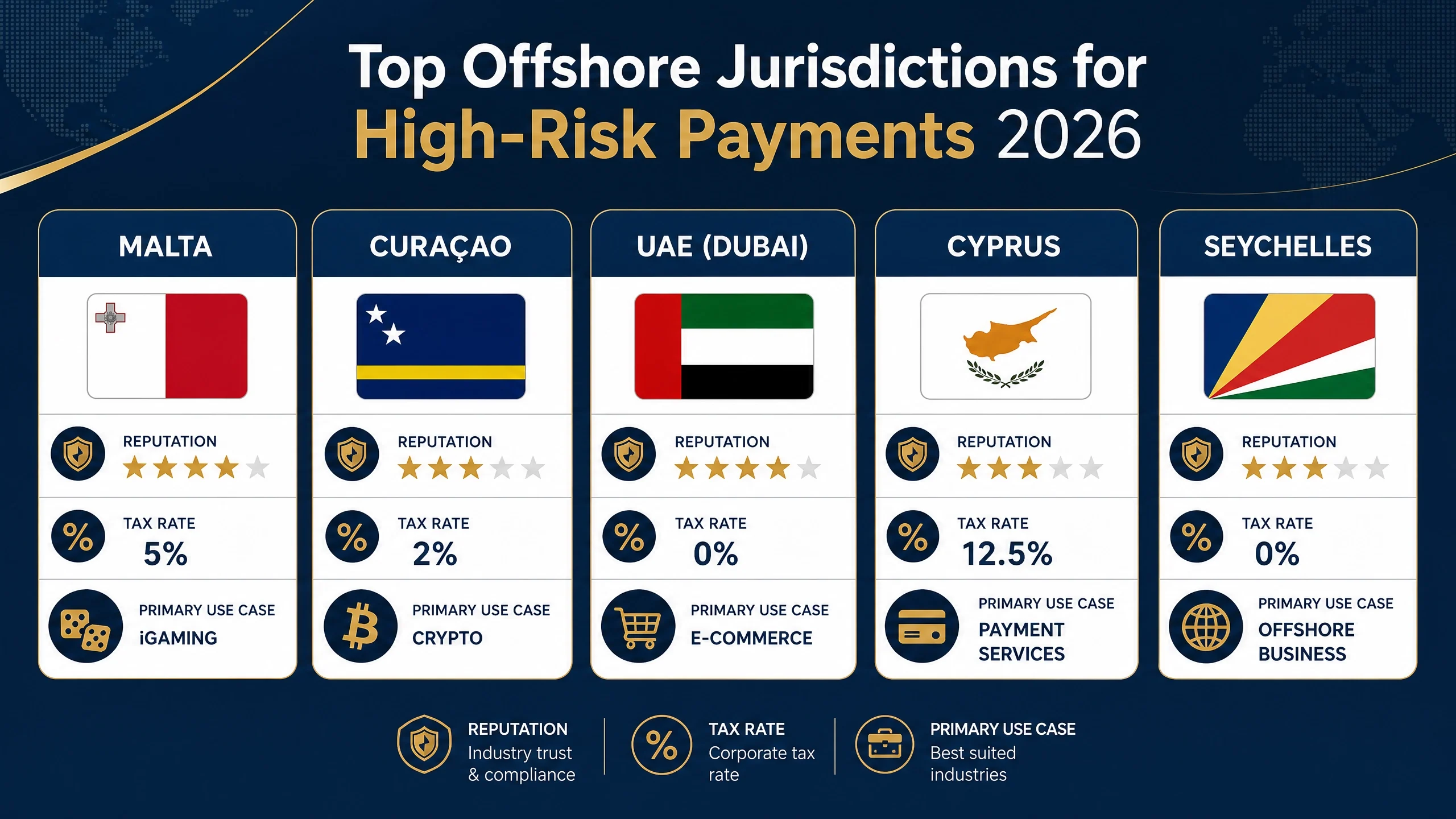
1. Malta - The Gold Standard for Regulated High-Risk Processing
Malta remains the most credible offshore jurisdiction for high-risk payment processing in 2026. As an EU member state, Malta-based companies access the European single market, EU card network acquiring, and SEPA payment rails, benefits no purely offshore jurisdiction can match.
Key advantages:
- Malta Financial Services Authority (MFSA) licensing provides internationally recognized regulatory credibility
- The Malta Gaming Authority (MGA) license is the global benchmark for iGaming and sports betting operators
- EU passporting allows Malta-licensed payment institutions to operate across all 27 EU member states without additional licensing
- FATF-clean, OECD-compliant, and fully within SWIFT correspondent banking networks
- Robust local acquiring bank ecosystem (Bank of Valletta, APS Bank, and several e-money institutions)
Limitations:
- Corporate substance requirements are genuine, Malta expects real offices, staff, and operations
- Licensing costs are significant: MGA licenses start at €25,000; EMI licenses require €350,000 in initial capital
- Compliance overhead is high relative to second-tier offshore jurisdictions
Best suited for: iGaming operators, forex brokers, crypto exchanges seeking EU regulatory credibility, high-volume online payments businesses.
2. Gibraltar - Crypto and Gambling's Most Respected Address
Gibraltar has carved out a uniquely credible niche at the intersection of traditional gambling licensing and emerging digital payments infrastructure. Its Distributed Ledger Technology (DLT) regulatory framework, introduced in 2018, was among the world's first coherent crypto licensing regimes, and it attracted serious operators.
Key advantages:
- Gibraltar Gambling Commissioner licensing is widely respected globally
- DLT Provider license gives crypto-focused payment providers and exchanges a regulated, internationally recognized credential
- Proximity to EU markets (despite post-Brexit status) and strong UK financial system integration
- Low corporate tax (10% flat rate) with clear substance rules
- Gibraltar's financial regulator (GFSC) operates transparently and is accessible to applicants
Limitations:
- Smaller local banking infrastructure than Malta; fewer acquiring bank options
- Post-Brexit loss of EU passporting for financial services
- Limited population base means most business must be conducted internationally, creating ongoing substance scrutiny
Best suited for: Gambling operators, crypto exchanges, fintech companies seeking a prestigious English-speaking jurisdiction with established DLT framework.
3. Dubai / UAE - The Fastest-Rising Tier-1 Jurisdiction
The UAE, particularly the Dubai International Financial Centre (DIFC) and Abu Dhabi Global Market (ADGM), has transformed into a genuine Tier-1 jurisdiction for high-risk payment processing and fintech infrastructure since 2020.
Key advantages:
- UAE removed from FATF grey list in 2024, dramatically improving correspondent banking relationships
- DIFC and ADGM offer common-law regulatory frameworks modeled on UK/international standards
- Zero corporate income tax in free zones (subject to OECD Pillar Two rules for large multinationals)
- Excellent international banking access; major global banks maintain significant UAE presence
- Dubai's VARA (Virtual Assets Regulatory Authority) provides one of the most developed crypto regulatory frameworks globally
- Strong cross-border payment infrastructure for MENA, South Asia, and Southeast Asia corridors
Limitations:
- Licensing costs and compliance requirements are substantial and continue to increase
- Political environment requires ongoing monitoring for international businesses
- Substance requirements are genuine and enforced
Best suited for: Cross-border payment processing, crypto and digital asset businesses, forex operators, high-volume digital payments platforms with Middle East or Asia-Pacific focus.
4. Curaçao - The High-Volume, Lower-Cost Option
Curaçao has historically been the default jurisdiction for iGaming operators seeking fast, low-cost licensing. Its master license structure, where a small number of license holders sublicense to operators, has allowed hundreds of online gambling and high-risk merchant businesses to operate quickly and affordably.
Key advantages:
- Very low licensing costs compared to Malta or Gibraltar
- Fast setup, companies can be operational within weeks
- Flexible regulatory environment accommodating a wide range of business models
- Established ecosystem of local service providers, banks, and payment companies
Limitations:
- Curaçao is undergoing significant regulatory reform (the new National Ordinance on Offshore Games of Hazard) which is tightening its previously lax framework, this is ongoing as of 2026
- Banking quality is inconsistent; some local banks have lost correspondent relationships due to AML concerns
- Lower international credibility than Malta or Gibraltar, some payment partners apply enhanced due diligence to Curaçao-licensed operators
- Processing fees tend to be higher due to acquiring bank risk pricing
Best suited for: iGaming startups, adult content platforms, and offshore merchants who need fast, low-cost market entry and can accept the credibility trade-off.
5. Seychelles - Flexible Forex and Corporate Structuring
The Seychelles is a longstanding offshore jurisdiction used heavily by forex brokers, trading platforms, and corporate structuring vehicles. Its Financial Services Authority (FSA) offers securities dealer and broker-dealer licenses that serve the forex industry.
Key advantages:
- Low setup and maintenance costs
- Fast incorporation and licensing timelines
- Flexible regulatory approach to forex and financial services
- No capital gains tax, no withholding tax on dividends
Limitations:
- Limited domestic banking infrastructure; most Seychelles-registered businesses bank internationally through correspondent relationships
- Credibility ceiling Seychelles licensing is viewed as entry-level by serious institutional counterparties
- Increasing pressure from FATF and OECD on substance requirements
Best suited for: Forex brokers seeking entry-level licensing, offshore merchant holding structures, early-stage fintech operations.
6. Georgia (Country) - The Emerging Fintech Hub
The Republic of Georgia: not to be confused with the U.S. state, has emerged as a surprising and genuine option for payment processing and fintech infrastructure, particularly for businesses operating in Eastern Europe, Central Asia, and beyond.
Key advantages:
- NBG (National Bank of Georgia) licensing for payment service providers is accessible and cost-effective
- Flat 15% corporate income tax, with virtual zone companies paying 0% on international revenue
- Strong banking infrastructure with international connectivity (TBC Bank, Bank of Georgia)
- FATF-clean with a stable regulatory environment
- Growing ecosystem of payment providers, processors, and fintech startups
Limitations:
- Less internationally recognized than EU jurisdictions
- Limited card network acquiring depth compared to Malta or UAE
- Geopolitical proximity to conflict zones may concern some banking partners
Best suited for: Fintech startups, high-risk merchant processing businesses, companies targeting CIS and Eastern European markets.
Jurisdictions to Approach With Caution in 2026
Panama: has historically been popular for forex and offshore corporate structures, but periodic FATF grey list appearances (including 2019–2023) have degraded its correspondent banking relationships significantly. Merchants using Panama-based processing report higher decline rates on international card transactions.
Vanuatu: forex licensing has attracted scrutiny from ASIC and other regulators. Its distance from major financial centers and thin banking infrastructure make it a third-tier option at best for serious payment processing operations.
Marshall Islands and Belize: continue to see use for corporate holding structures, but their domestic banking ecosystems are too thin to support meaningful card acquiring operations.
How to Choose the Right Offshore Jurisdiction for Your Business
The right jurisdiction depends on your specific business model, risk profile, and growth trajectory. Consider the following decision framework:
If international card network access and credibility are paramount → Malta or UAE
If gambling or crypto licensing is the primary need → Malta (iGaming), Gibraltar (both), UAE (crypto)
If speed and low cost are the priority → Curaçao or Seychelles
If you are targeting cross-border payments in MENA or Asia → UAE
If you are building a regulated fintech or EMI → Malta (EU passporting) or Gibraltar
If you need a corporate holding structure alongside a payment layer → Cayman Islands + operational entity in Malta or UAE
Frequently Asked Questions
Q: What is the FATF grey list and why does it matter for offshore payment processing? The FATF (Financial Action Task Force) grey list identifies countries under increased monitoring for AML/CFT deficiencies. When a jurisdiction is grey-listed, its banks face enhanced due diligence from international correspondent banks, which results in higher transaction costs, more frequent declines, and reduced access to the global SWIFT network. For offshore merchants, a grey-listed processor jurisdiction directly reduces payment processing reliability.
Q: Can offshore merchant accounts access Visa and Mastercard? Yes, but access quality varies by jurisdiction. Tier-1 jurisdictions (Malta, UAE, Gibraltar) host banks that are principal members of the card networks, providing direct, high-quality acquiring. Tier-2 and Tier-3 jurisdictions often rely on sponsored membership through international correspondent banks, which can limit card acceptance rates and increase processing fees.
Q: How much does it cost to set up an offshore merchant account? Setup costs vary widely. Incorporation in a jurisdiction like Seychelles or BVI may cost $1,000–$3,000. Obtaining a payment processing license (e.g., Malta EMI license) requires €350,000 in capital plus significant ongoing compliance investment. Offshore merchant accounts without a local license, obtained through an existing licensed processor, can be set up for a few hundred dollars, though with higher fee rates.
Q: Are offshore merchant accounts legal? Yes, when properly structured. Offshore payment processing is legal when the merchant complies with the laws of both their home country and the offshore jurisdiction, reports income correctly to relevant tax authorities, and does not use the offshore structure for fraud, tax evasion, or money laundering. Proper legal and compliance advice is essential.
Q: What processing fees should offshore merchants expect? Tier-1 offshore jurisdictions (Malta, UAE) typically offer rates comparable to domestic high-risk processing: 2.5–4.5%. Tier-2 jurisdictions (Curaçao, Seychelles) typically run 3.5–5.5%. Tier-3 jurisdictions (Vanuatu, some Panama arrangements) can reach 5–7% or more, with rolling reserves of 10–15%.
Q: What is a rolling reserve in offshore processing? A rolling reserve is a percentage of processing volume, typically 5–15%, held back by the acquiring bank as a security buffer against chargebacks and refunds. It is returned on a rolling basis (usually after 90–180 days) as long as the account remains in good standing.
Conclusion: Jurisdiction Selection Is a Strategic, Not a Tactical, Decision
The best offshore jurisdiction for high-risk payment processing is not the cheapest or the fastest, it is the one that best matches your business model's risk profile, growth trajectory, and compliance posture. In 2026, the gap between Tier-1 jurisdictions (Malta, UAE, Gibraltar) and lower-tier alternatives is large and consequential: better card network access, lower decline rates, more stable banking relationships, and greater credibility with international payment partners.
For high-volume operators, the investment in a properly structured, Tier-1 offshore jurisdiction pays for itself in lower processing costs, fewer account terminations, and access to acquiring bank relationships that simply are not available in lower-tier locations. https://thefinrate.com/best-offshore-jurisdictions-for-high-risk-payment-processing-2026-comparison/


Comments
Post a Comment