Best Merchant Services in 2026: Real Costs, Top Providers & How to Actually Choose
What "Best Merchant Services" Actually Means in 2026
Most "best merchant services" guides rank providers by brand recognition, affiliate commission rate, or a generic feature checklist assembled by someone who has never read a processing statement. That is not what this guide does.
In 2026, the best merchant services for your business is determined by exactly four things:
- Your effective rate: not the headline rate, not the advertised rate. The actual all-in percentage of your gross card volume that goes to your processor after every fee, surcharge, downgrade, and compliance cost is accounted for.
- Account stability: whether your processing account stays live and funded without freezes, holds, or sudden terminations. For standard businesses, this is rarely tested. For high-risk businesses, it is the single most important variable.
- Post-onboarding support: what happens after you sign. Most payment horror stories start not at onboarding but six months later, when a chargeback dispute stalls, a fee line item appears with no explanation, or a rate hike arrives via a single-paragraph email.
- Fit to your actual payment model: in-person, online, recurring, B2B invoicing, multi-location, or multi-currency. A world-class processor that doesn't integrate with your stack is not a world-class processor for your business.
Globally, digit
al payments continue to expand, with the annual volume of non-cash transactions expected to hit 3.54 trillion by 2029, according to Capgemini's 2026 World Payments Report. In that environment, the merchant services decision is not a one-time setup task. It is an ongoing infrastructure choice with compounding cost implications.
The 3 Pricing Models - and Which One Is Costing You the Most
Before you compare a single provider, you need to understand the pricing model they are offering you. This is where most merchants get quietly burned, not by the provider itself, but by a model that is structurally designed to obscure its true cost.
Flat-Rate Pricing (Square, Stripe, PayPal)
One fixed percentage plus a per-transaction fee for every payment, regardless of card type. Simple and predictable, but that simplicity has a price.
Square raised rates by 14% in January 2026 without telling merchants beforehand. When you are on flat-rate pricing, the processor can increase your effective rate by quietly reclassifying transactions, and without interchange-plus line items on your statement, you may not notice for months. For most businesses, flat-rate pricing stops being competitive somewhere between $8,000 and $15,000 per month in card volume. Below that threshold, the simplicity may be worth it. Above it, you are almost certainly overpaying.
Tiered Pricing (Qualified / Mid-Qualified / Non-Qualified)
The most widely used model in traditional merchant services, and the least transparent. A processor advertises a "qualified" rate of, say, 1.79%. The reality is that only a fraction of your transactions qualify for that tier. A retail client came in confused about their high processing costs. Their processor advertised a qualified rate of 1.79%, but their statement told a different story. Only 20% of transactions qualified for the lowest rate, 45% fell into mid-qualified, and 35% landed in non-qualified. Their effective rate was actually 2.89%.
Tiered pricing benefits processors, not merchants. If a provider quotes you tiered pricing, they are prioritizing their margins over your visibility.
Interchange-Plus Pricing (The Transparent Standard)
Interchange-plus separates your processing costs into three visible line items: the interchange fee set by Visa or Mastercard, the card network assessment fee, and the processor's markup. The processor markup is the only negotiable component, and because it is explicitly disclosed, you can audit it, compare it, and negotiate it down over time.
Interchange-plus gives businesses transparency, control, and scalability. Tiered pricing, while simple, often hides true costs and grows more expensive over time. For any business processing more than $10,000 per month, interchange-plus pricing is almost always the lower-cost model. In the U.S., the average interchange fee is about 1.81%. In-person payments average 1.71%, while online transactions are higher at 1.91% due to greater fraud risk.
Bottom line: If your provider cannot show you a statement with interchange and markup as separate line items, you are on a model that is structured to hide costs from you.
The Real Cost Breakdown: What You're Actually Paying
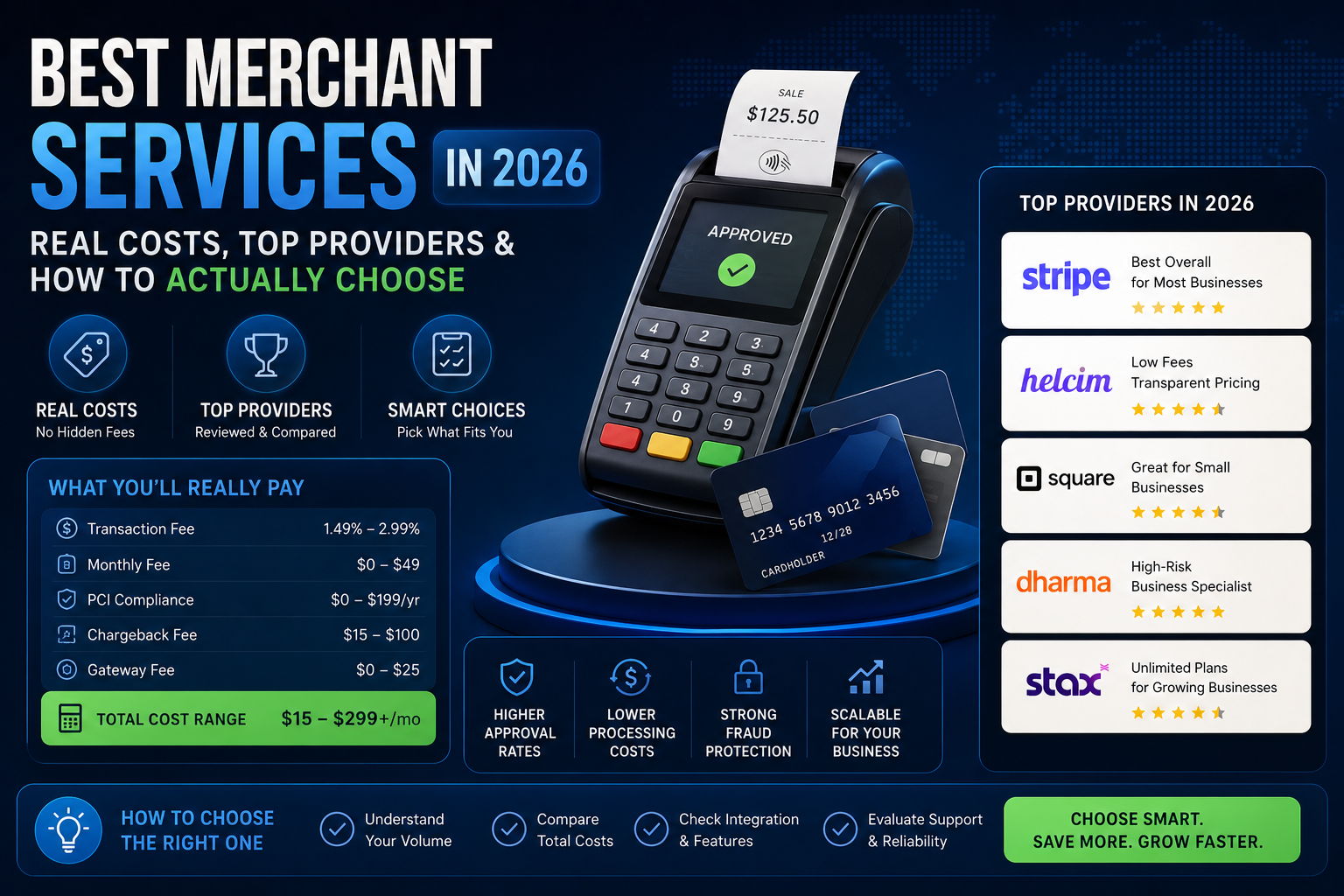
Here is a realistic, complete fee picture for merchant services in 2026, not marketing copy, but actual cost categories you will encounter on your statement:
Fee Category
Typical Range
Notes
Interchange fees
0.05% – 2.40%
Set by Visa/Mastercard; non-negotiable
Network assessment fees
0.13% – 0.15%
Non-negotiable; charged by card networks
Processor markup (interchange-plus)
0.10% – 0.75% + $0.05–$0.15
The only negotiable line item
Flat rate (aggregators)
2.6% – 3.5% + $0.10–$0.30
Includes all of the above, bundled
Monthly account fee
$0 – $99
Standard merchants: $0–$25; high-risk: $25–$100
Payment gateway fee
$10 – $50/month
Often separate from processing fees
PCI compliance fee
$4 – $20/month
Charged by most processors
Chargeback fee
$15 – $100/dispute
Standard: $15–$25; high-risk: $25–$100
Early termination fee
$0 – $750
Many traditional processors charge this
Annual fee / rate review increase
Varies
Watch for this 12–18 months after signing
The number that actually matters is your effective rate, total processing fees divided by total card volume. For a well-optimized standard merchant account in 2026, a healthy effective rate falls between 1.8% and 2.4% for card-present businesses and 2.1% to 2.9% for online-first businesses. If your effective rate is above these ranges and you are not in a high-risk category, your pricing model is almost certainly the problem, not the volume or card mix.
Top Merchant Services Providers in 2026: Full Comparison
For Standard & Scaling Businesses
Helcim: Best for transparent pricing with no monthly fees. Helcim uses interchange-plus pricing with no contracts and no hidden charges, making it one of the most cost-effective choices for businesses that want clear, auditable statements. Strong for both in-person and online acceptance. Weakness: no high-risk industry support.
Stripe: Best for developer speed and online-first businesses. Stripe's flat-rate model and API depth make it the fastest path from zero to accepting payments. However, convenience can get expensive at scale; verify your effective rate and add-on fees before assuming Stripe is the right long-term solution.
Stax (formerly Fattmerchant): Best for high-volume merchants who want subscription-style pricing. Monthly subscription plus direct interchange pass-through can deliver strong savings at volumes above $25,000/month, but only if the math actually works for your card mix. Always calculate your all-in effective rate before assuming the subscription model saves you money.
Elavon: Best for mid-market businesses that need stability and broad compatibility. Elavon can be a solid answer for businesses processing $2M–$10M annually, particularly when stability, broad acceptance coverage, and established bank relationships matter. Success depends heavily on how the deal is structured, negotiate aggressively and document every term.
Fiserv: Best for enterprise scale with broad ecosystem integration. Fiserv supports more than 6 million business locations and processes upward of 25,000 transactions per second at peak. With that scale comes variability in pricing and support, benchmarking and direct negotiation are essential before signing.
Adyen: Best for global commerce and complex enterprise requirements. Adyen is frequently the right conversation for businesses with significant international volume and complex routing needs. It can be operationally demanding, best suited to businesses with a dedicated finance or payments operations function.
Square: Best for simple POS needs and quick launches. Square works well for businesses that need immediate in-person acceptance with minimal setup. At scale, its flat-rate model becomes expensive, and its automated risk systems can abruptly terminate accounts in sensitive categories with little warning or recourse.
For High-Risk Businesses
High-risk merchants, SaaS with subscription billing, nutraceuticals, CBD, iGaming, fintech lending, adult entertainment, forex, and others, cannot use the providers above as their primary processing solution. Standard processors decline high-risk MCCs automatically, and even when they initially accept an account, they will terminate it once automated risk systems flag the business model. The providers below are built specifically for high-risk payment processing.
PaymentCloud: Best overall for high-risk eCommerce. Hands-on underwriting, gateway-agnostic architecture, and one of the few providers that works with MATCH-listed merchants on a case-by-case basis.
Easy Pay Direct: Best for SaaS and high-volume subscription businesses. Multi-MID architecture allows multiple merchant accounts through a single portal, providing the processing redundancy that high-risk subscription businesses require.
Durango Merchant Services: Best for international and complex risk profiles. Supports more than 26 currencies across 200+ countries, with particular strength in offshore and hard-to-place merchant placements.
SecureGlobalPay: Best for terminated merchants and hard-to-place industries. Full-service domestic and offshore merchant accounts with AI-powered fraud detection and dedicated account management.
eMerchantBroker (EMB): Best for high-chargeback verticals. Adaptive AI fraud protection and deep experience with industries that structurally generate elevated dispute rates.
The High-Risk Gap Most Comparison Guides Ignore
Most "best merchant services" guides, including the major ones published by Forbes, NerdWallet, and competing fintech publications, cover the same shortlist of 8–10 mainstream processors and stop there. For approximately 30–40% of businesses operating in fintech, SaaS, eCommerce, and regulated industries, this advice is not just incomplete. It is actively harmful, because it directs merchants toward providers who will freeze or terminate their accounts within weeks.
The reality of the high-risk payment processing landscape in 2026 is this: if your business falls into any of the following categories, you need a dedicated high-risk merchant account, not a standard merchant account with a higher rate, but a fundamentally different processing infrastructure:
- SaaS or subscription billing with recurring charges
- Nutraceuticals, supplements, or health-adjacent products
- CBD or hemp-derived products
- iGaming, online gambling, or daily fantasy sports
- Fintech, lending, or credit repair services
- Adult entertainment or dating platforms
- Forex, CFD trading, or crypto exchanges
- Travel, IPTV, or high-ticket eCommerce
- Any business with a chargeback rate above 0.5%
Nearly every high-risk merchant account provider promises fast approvals and low rates. In reality, those claims are impossible to verify upfront, and often depend on your business model, processing history, and risk profile. The key is to evaluate providers based on industry specialization, acquiring bank relationships, chargeback management tools, and transparency of reserve terms, not marketing promises.
Best Merchant Services by Business Type
Business Type
Primary Need
Top Recommendation
Early-stage eCommerce
Fast setup, low upfront cost
Stripe, Helcim
Scaling eCommerce ($10K+/mo)
Transparent pricing, low effective rate
Helcim, Stax
SaaS / Subscription billing
Recurring billing, chargeback resilience
Easy Pay Direct, PaymentCloud
High-risk eCommerce
Account stability, multi-MID
PaymentCloud, EMB
Mid-market ($2M–$10M revenue)
Negotiated terms, post-onboarding support
Elavon, Fiserv (negotiated)
Enterprise / Global
Multi-currency, complex routing
Adyen, Checkout.com
Brick-and-mortar retail
POS reliability, card-present rates
Helcim, Square (low volume)
B2B / Invoice-based
Level 2/3 data, ACH, recurring
QuickBooks Payments, Stax
MATCH-listed / Terminated
Reentry, offshore options
SecureGlobalPay, Durango
Crypto / Web3
No underwriting, fast settlement
NOWPayments
Global Coverage: USA, UK, Canada & LATAM
🇺🇸 United States
The U.S. market has more merchant services providers than any country in the world, and more variability in pricing, contract terms, and support quality. PCI DSS 4.0 compliance requirements came into full effect in 2025, making security infrastructure a non-negotiable evaluation criterion. Standard merchants should prioritize interchange-plus pricing and verifiable post-onboarding support. High-risk merchants USA should work exclusively with domestic or offshore processors that specialize in their vertical.
🇬🇧 United Kingdom
Post-Brexit regulatory divergence from EU PSD2 has created unique compliance obligations for UK merchants, particularly around Strong Customer Authentication (SCA) and cross-border transaction routing. UK merchants benefit from FCA-regulated acquiring relationships and strong 3D Secure 2.0 implementation. Adyen, Checkout.com, and Stripe all have strong UK infrastructure. High-risk UK merchants should work with processors familiar with FCA-registered partners.
🇨🇦 Canada
Canada's open banking framework is maturing, and several provinces are pushing forward with digital payment infrastructure improvements. Canadian merchants benefit from strong North American acquiring networks shared with U.S. processors. FINTRAC AML compliance obligations apply to most payment service providers. Merchants processing across the U.S.-Canada border should prioritize processors with dual-jurisdiction coverage.
Latin America (LATAM)
In ecommerce, digital wallets accounted for 53% of transaction value in 2024, and they are projected to reach 65% by 2030. LATAM is one of the fastest-growing digital payment markets globally, led by Brazil, Mexico, and Colombia. Currency volatility, cross-border banking restrictions, and inconsistent regulatory frameworks across countries make specialized processing essential. For LATAM-focused merchants, multi-currency support, local payment method acceptance (PIX in Brazil, OXXO in Mexico, PSE in Colombia), and crypto payment rails are all viable components of a complete payments stack.
Five Warning Signs You're With the Wrong Provider
Many businesses stay with a bad merchant services provider long after the red flags appear, either because switching feels complicated or because they don't know what they should be comparing against. Here are the five most reliable signals that you are being overcharged or underserved:
1. You cannot explain your own statement. If you cannot describe your pricing model in one sentence or identify what each fee line item represents, your processor is not operating transparently. This is almost always intentional.
2. Your effective rate has increased since onboarding without a direct conversation. Rate creep through tiered pricing reclassification, new fee line items, or annual "policy adjustments" is standard practice at many traditional processors. If your effective rate today is higher than it was at month three without a volume or card mix change, someone is quietly extracting margin from your account.
3. Your account was frozen or your funds were held without a clear explanation. This is the cardinal sin of payment processing. Legitimate processors communicate reserve changes, volume reviews, and risk triggers directly and in advance. A processor that freezes your funds and directs you to a generic support ticket system is not a partner, it is a liability.
4. You cannot reach a named human being when something goes wrong. Support quality is the single most underrated dimension of merchant services selection. Most merchants don't realize they're buying support until they need it. Then it's too late.
5. You are a high-risk business using a standard aggregator. If your business operates in a high-risk category and your primary processor is Stripe, Square, or PayPal, your account is at risk of termination at any moment. This is not a criticism of those processors, it is simply how their automated risk systems are designed to work. The right infrastructure for your business is a dedicated high-risk merchant account with an acquiring bank that actively underwrites your specific industry.
9. How to Switch Merchant Services Without Disrupting Operations
Switching processors is a concern that keeps many merchants locked into bad arrangements far longer than necessary. Here is a practical framework for doing it without operational disruption:
- Run parallel processing during transition. Keep your existing processor active while onboarding the new one. This eliminates downtime risk during integration and provides a fallback if the new account has a delayed approval.
- Map all integrations before you apply. Identify every system connected to your current gateway, eCommerce platform, CRM, billing software, ERP, and reporting tools, and confirm compatibility with the new provider before you commit.
- Request a processing history letter from your current processor. A clean 3–6 month processing history summary significantly improves underwriting outcomes with your new provider and can positively affect reserve terms.
- Understand your termination obligations. Early termination fees range from $0 to $750 with traditional processors. Review your existing contract before initiating a switch and time the transition accordingly.
- Do not cancel your old account immediately. Maintain your existing account for 30–60 days after going live with the new processor to ensure settlement is complete and any pending chargebacks are resolved.
Most merchant services switches can be completed in 2–4 weeks for standard businesses. Complex environments with custom integrations, high-risk underwriting requirements, or offshore acquiring relationships may take 4–8 weeks.
10. Frequently Asked Questions
Q: What is the best merchant services provider for a small business in 2026?
For small businesses processing under $10,000 per month, Helcim or Square offer the best balance of simplicity, transparency, and cost. For businesses above that threshold, an interchange-plus provider with a dedicated account manager delivers better economics. For any small business in a high-risk category, standard processors are not viable, a dedicated high-risk merchant account is required regardless of volume.
Q: How do I know if I'm overpaying for payment processing?
Calculate your effective rate: divide total processing fees by total card volume for the same period. For card-present retail, a competitive effective rate in 2026 is 1.8%–2.2%. For online-only businesses, 2.1%–2.7% is a healthy benchmark. https://thefinrate.com/best-merchant-services-in-2026-real-costs-top-providers-how-to-actually-choose/


Comments
Post a Comment